Salary day moves by a week, a large bill lands early, and on the morning your ₹10,000 SIP is due, your bank account holds ₹6,200. The auto-debit fails. By evening, two questions arrive together: has the fund house fined you, and has one bad month broken a plan you have run for years?
The short answer calms both fears: the fund house charges no penalty for a missed SIP instalment, your existing units stay exactly where they were, and a single miss does not cancel a monthly SIP. The longer answer has one real cost — a charge your bank, not the fund house, may levy for the failed debit — plus one deadline worth knowing, because three failed debits in a row do end a monthly SIP.
What happens on the day your SIP debit fails
A SIP runs on a standing instruction: on your chosen date, the fund house asks your bank to move the SIP amount under the NACH or ECS mandate you signed at set-up. If the account does not hold enough money, the bank returns the instruction unpaid, and the fund house receives a failure report instead of money.
Three things follow, and only three. First, no units are allotted for that month: the fund house cannot buy units with money it never received. Second, your existing units are untouched: every unit bought earlier stays invested and keeps moving with the scheme's NAV. Third, the SIP itself stays alive: the next month's debit is attempted on the next date as usual, provided the account holds enough money by then.
A missed instalment is also not made up automatically: the fund house does not debit double the next month or chase you for the shortfall. Whether the missed month is ever replaced is your decision — and the worked example below shows that the cost of a gap depends heavily on when in the plan it falls. A debit can also fail for other reasons — an expired mandate or a closed account — with the same sequence, but the bank charge described next is tied to debits returned for insufficient funds, the common case this article prices.
Who charges what: the fund house charges nothing, your bank may charge
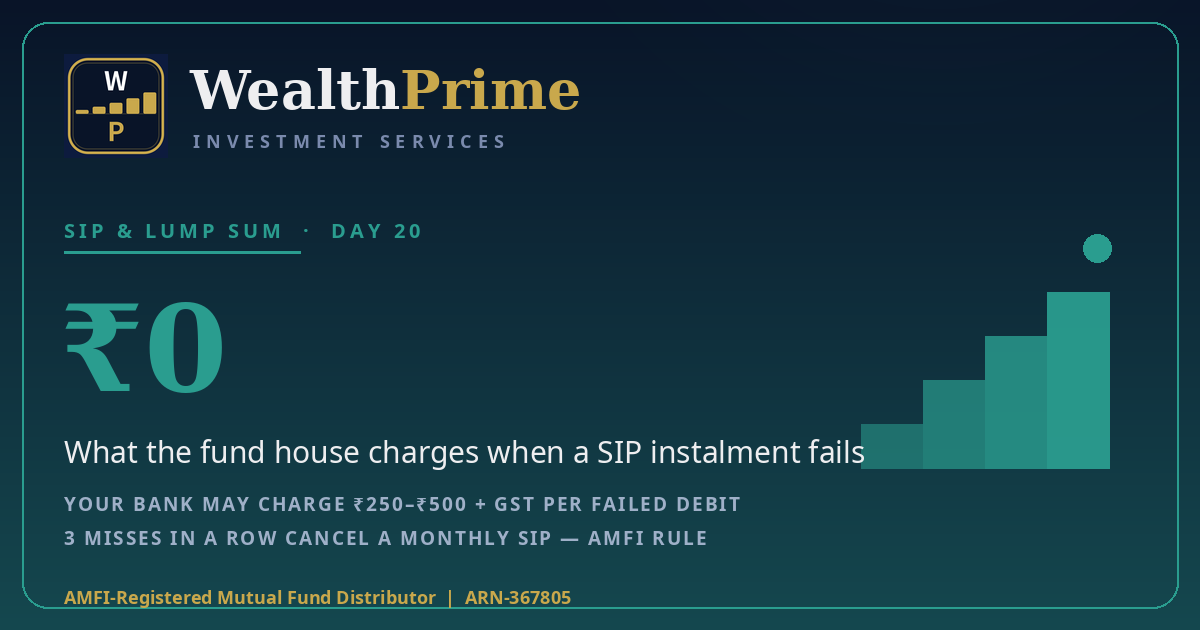
The penalty question has two answers because two institutions are involved. The asset management company — the fund house that runs your scheme — levies no penalty, late fee or processing charge when a SIP instalment fails. Fund houses' own investor-education material states this plainly: a missed instalment is a failed transaction, not a default, because a SIP is a voluntary investment instruction, not a loan repayment you owe the fund house.
Your bank sits in a different position. When it returns a NACH or ECS debit unpaid for insufficient funds, it levies an auto-debit return charge — often called a bounce charge — under its own published schedule of charges, with goods and services tax added on top. The charge differs by bank and account type; the figures below are the range large banks' schedules commonly show, and your own bank's current schedule is the figure that applies to you.
| Charge | Who levies it | How much |
|---|---|---|
| Penalty for a missed SIP instalment | The fund house (AMC) | ₹0 — no penalty, late fee or processing charge |
| Auto-debit (NACH/ECS) return charge, debit failed for insufficient funds | Your bank, per its schedule of charges | Typically ₹250 to ₹500 per failed debit, plus 18% GST — ₹295 to ₹590 in total |
| Several SIPs failing on the same day | Your bank, once per failed debit | Each debit is charged separately: three SIPs failing together can cost 3 × ₹590 = ₹1,770 |
| Effect on your credit score | Credit bureaus | None — a SIP is an investment, not a borrowing, and a failed SIP debit is not reported as a loan default |
Two consequences follow. The cost of a miss is set by how many debits fail, not by how large the SIP is: a ₹2,000 SIP and a ₹50,000 SIP that bounce on the same day attract the same per-debit charge. And an investor running several SIPs from one thin account on one date carries several times the exposure of an investor running one — which is why the recovery steps below include keeping a buffer in the debit account.
The worked example: what one missed ₹10,000 instalment actually costs
Separate the bank charge, which is immediate, from the investment gap, which is quiet and larger. Take a ₹10,000 monthly SIP run for 20 years — 240 instalments, ₹24,00,000 invested. Assume returns of 12% a year, compounded monthly, each instalment invested at the start of its month. That 12% is an assumption for this illustration only — not a forecast or a promise of what any fund will earn — and past performance is not indicative of future returns.
If every instalment is invested, the SIP ends at ₹99,91,479. Miss exactly one instalment and never replace it: if the missed instalment is the second one, that ₹10,000 would have compounded for almost the full 20 years to ₹1,07,847, and the plan finishes at ₹98,83,632. If the missed instalment is the final one, it would have been worth ₹10,100, and the plan finishes at ₹99,81,379.
Read the chart the right way round. One miss, even an early one, trims about 1% off a 20-year outcome, because one instalment is one two-hundred-and-fortieth of the money invested. The miss does not derail the plan; a habit of missing does. An investor who wants to close a gap can invest the missed amount as a one-time purchase in the same scheme in a later month, returning the plan's total invested to ₹24,00,000. You can run the same arithmetic on your own amount in the SIP calculator, at a return assumption you set yourself.
A missed SIP instalment costs you ₹0 in fund-house penalties and one month of units — but your bank may charge ₹295 to ₹590 for the failed debit, and an early ₹10,000 gap left unreplaced for 20 years is worth ₹1,07,847 at an illustrative 12% p.a. Resume the SIP first; replace the gap if you can.
Three misses in a row: when the SIP itself is cancelled
A single miss changes nothing about the SIP's registration, but repeated misses do. Under the standardised framework AMFI applies from 1 April 2024, three failed debits in a row automatically cancel a daily, weekly, fortnightly or monthly SIP; for SIPs running every two months, quarterly or at longer intervals, two in a row cancel it. The mandate stops being presented and no further debits are attempted.
Cancellation still does not touch what you own: every unit bought before it stays invested, and can be kept, redeemed or switched under the scheme's normal rules, including any exit load or lock-in. Cancellation removes only the future instruction — to invest monthly again, you register a fresh SIP with a fresh mandate. There is no waiting period and no penalty for registering again. The practical line is simple: one miss is an accident, two in a row are a warning to act before the third debit date, and three in a row convert a pause you did not choose into a cancellation you must repair with fresh paperwork.
Pause, stop, or let it fail? Three very different doors
Most fund houses offer a SIP pause facility: you instruct the fund house in advance to skip a set number of instalments — commonly one to six months, varying by fund house — and the SIP resumes on its own when the pause ends. Because a paused instalment is never presented to the bank, a pause produces no failed debit and no bank charge. Stopping is the permanent version: no further debits, existing units stay invested, restarting means a new SIP.
| Route | What you do | Bank charge? | What happens next |
|---|---|---|---|
| Pause the SIP | Instruct the fund house in advance to skip 1–6 instalments (limits vary) | No — no debit is attempted | The SIP resumes automatically after the pause; units already bought stay invested |
| Stop the SIP | Instruct the fund house to end the instruction | No — no debit is attempted | No further instalments; restarting needs a fresh SIP and mandate |
| Let the debit fail | Nothing — the account simply lacks the money | Yes — typically ₹295 to ₹590 per failed debit, bank's schedule | One miss: the SIP continues. Three in a row (monthly): the SIP is cancelled |
Pausing and failing produce the same investment gap — no units bought for the skipped months — but pausing produces it for free, in advance, with the restart arranged, while failing produces it at up to ₹590 a month, with cancellation waiting at the third consecutive failure. Where no pause is offered for a particular SIP, reducing the amount for a few months achieves a similar result: a smaller debit that succeeds costs nothing. New investors can see how dates, mandates and amounts fit together in our guide on how to start a SIP in India.
Getting back on track in three steps
Step one: fund the account before the next date, and check the mandate. Confirm the mandate points to the account your salary reaches, that it has not expired, and that the balance will cover every debit due that week — not just the SIP that failed. Most single misses end here: the next debit succeeds and the SIP continues.
Step two: decide about the gap, once. Either replace the missed amount as a one-time purchase in the same scheme, or accept the gap and move on — the worked example prices both choices. Doubling the SIP for a month out of guilt, then struggling again the month after, helps no one: the plan that survives is the one whose amount the salary can carry in an ordinary month, which you can test in the SIP calculator linked above.
Step three: if tight months are ahead, instruct — do not drift. Pause the SIP, reduce its amount, or move its date to just after salary credit, before the next debit is presented. Each instruction is free and takes minutes; each uninstructed failure costs a bank charge and moves the SIP closer to automatic cancellation. Investors resetting an instruction can review funds side by side in the explorer — but for most missed instalments the scheme was never the problem; the fix is the calendar and the buffer, not the fund.
Frequently asked questions
Does the fund house charge a penalty if I miss a SIP instalment?
No. The asset management company levies no penalty, late fee or processing charge for a missed SIP instalment: no units are allotted for that month, your existing units stay invested, and the SIP continues the next month. The only charge in most cases comes from your bank, which may levy an auto-debit return charge — typically ₹250 to ₹500 plus 18% GST — when a debit fails for insufficient funds.
How many SIP instalments can I miss before my SIP is cancelled?
Under AMFI's standardised framework in force from 1 April 2024, three consecutive failed debits cancel a daily, weekly, fortnightly or monthly SIP, and two consecutive failed debits cancel a SIP that runs every two months, quarterly or at longer intervals. Cancellation stops future debits only — the units you already hold stay invested, and you can register a fresh SIP without any waiting period.
Will a missed SIP instalment affect my credit score?
No. A SIP is a voluntary investment instruction, not a loan or a credit line, so a failed SIP debit is not reported to credit bureaus as a default and does not lower your credit score. That is different from a bounced loan EMI or credit-card auto-debit, which is a repayment failure and is reported.
Can I pause my SIP instead of missing instalments?
Yes, where the fund house offers a pause facility for your SIP. A pause instructs the fund house in advance to skip a set number of instalments — commonly one to six months, varying by fund house — after which the SIP resumes automatically. Because no debit is attempted during a pause, the bank levies no return charge, unlike a debit that is presented and fails.
The bottom line
A missed SIP instalment is a smaller event than it feels on the day: the fund house charges ₹0, allots no units for that month, leaves every existing unit invested, and attempts the next debit as usual. The real costs sit at the edges — a bank return charge of typically ₹295 to ₹590 for each debit that fails for insufficient funds, an early ₹10,000 gap worth ₹1,07,847 after 20 years at an illustrative 12% p.a. if it is never replaced, and automatic cancellation after three consecutive failed debits on a monthly SIP. Fund the account, decide about the gap once, and instruct a pause whenever tight months are visible ahead — those three habits make a missed instalment what it should be: a skipped month, not a broken plan.
Sources: AMFI's standardised SIP cancellation framework in force from 1 April 2024 (three consecutive failed debits for daily, weekly, fortnightly and monthly SIPs; two for bi-monthly, quarterly and longer intervals), as described in fund houses' investor-education material; fund-house statements that no AMC penalty applies to a missed instalment; bank auto-debit return charges from banks' published schedules of charges, which vary by bank and account type — check your own bank's current schedule. All ₹ investment figures are the author's calculations at the stated assumptions — an illustration, not a forecast.
A Tight Month Coming Up? Pause, Don't Bounce
A planned pause costs nothing; a bounced debit can cost ₹590 a time, and three in a row cancel the SIP. Talk to us on a free, no-pressure call about pausing or resizing your SIPs until cash flow eases — your existing units stay invested either way.
Prefer chat? WhatsApp us