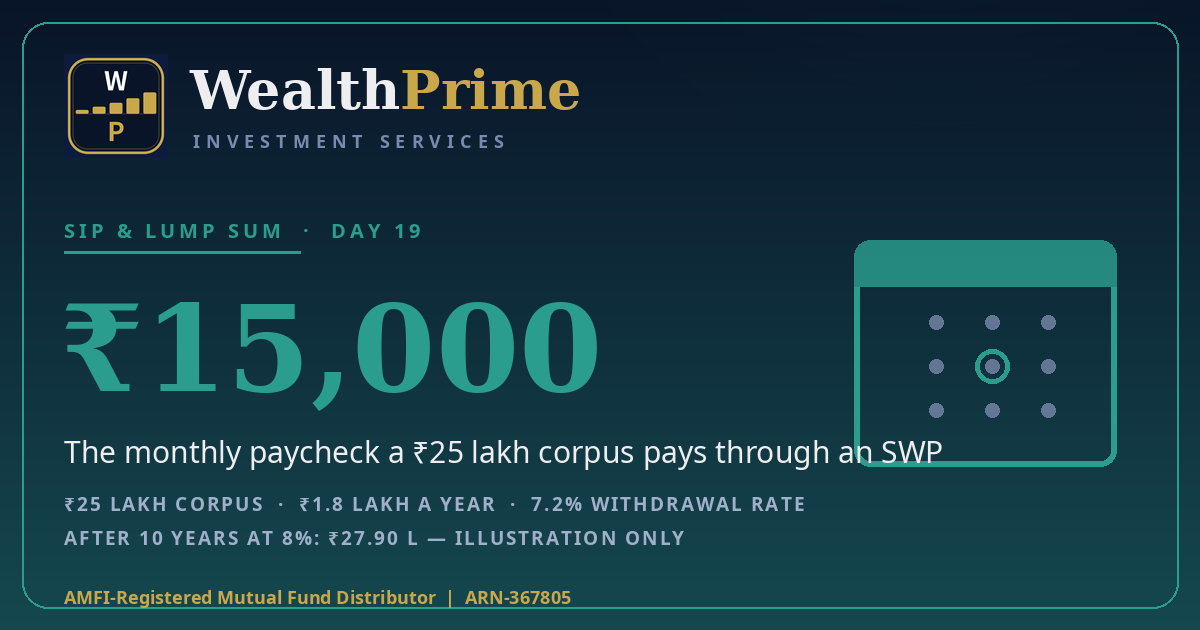
A salary works in one direction: money arrives every month, and life is arranged around that rhythm. An SWP — a Systematic Withdrawal Plan — rebuilds the same rhythm in reverse, from money already invested: the fund redeems a fixed amount of your units every month and pays the proceeds into your bank account.
An SWP is not a product and it is not income the fund earns for you. An SWP is an instruction — an amount, a date and a fund — and every payment comes out of your own corpus, unit by unit. That single fact explains how the payment is calculated, why your unit count falls every month, how each payment is taxed, and why the withdrawal amount, measured against the corpus, decides how long the money lasts. This post works through each point on one example: a ₹25 lakh corpus paying ₹15,000 a month.
What an SWP is, and how each monthly payment happens
An investor who sets up an SWP gives the fund house a standing instruction with three parts: the fund the money sits in, the amount to withdraw (a fixed rupee amount, or in some plans a fixed number of units), and the date each month on which the withdrawal should happen. The investor can start an SWP from an existing lump sum, and most fund houses also allow an SWP to begin after a chosen waiting period.
On each SWP date, the fund house redeems exactly enough units to make up the fixed amount at that day’s NAV, and credits the proceeds to the investor’s registered bank account, typically within a few working days depending on the fund category. The units that remain stay invested. Nothing is set aside in cash in advance: the payment is a part-sale of your own holding, repeated monthly.
Three consequences follow. First, your unit balance falls every month, without exception — what changes is only how fast. Second, the fund does not promise that the corpus will last any particular number of years; the instruction runs until you stop it or the units run out. Third, because the amount is fixed in rupees while the NAV moves, a falling market redeems more units for the same ₹15,000 than a rising market does — the mirror image of what a SIP does when it buys. The worked example below puts numbers on all three points.
An SWP instruction can also be changed or stopped: the amount, the date and the frequency (most funds offer monthly and quarterly options) can be modified, with a fresh instruction taking effect from a later instalment under the fund house’s processing timelines. Stopping the SWP does not redeem the fund — the remaining units simply stay invested.
SWP vs IDCW: two ways a fund pays money out, only one of them yours to set
The other payout route is the IDCW option — Income Distribution cum Capital Withdrawal, the option called the dividend option until SEBI renamed it in 2021. The new name states the mechanics honestly: an IDCW payout also comes out of the fund’s own assets, and the fund’s NAV falls by roughly the payout amount on the payout date. It is not extra money on top of your investment; it is a slice of your investment handed back.
| Point | SWP | IDCW option |
|---|---|---|
| Who sets the amount | You — a fixed amount you choose | The fund house — declared per unit, when declared |
| Who sets the timing | You — a fixed date, monthly or quarterly | The fund house — payouts can be irregular, reduced or skipped |
| Where the money comes from | Units redeemed from your holding at that day’s NAV | The fund’s distributable surplus; the NAV falls by about the payout |
| What is taxed | Only the gain part of each withdrawal, at the capital-gains rates for that fund type | The full payout, taxed in your hands at your income-tax slab rate |
| Control over the total taken out | Exact — the instruction runs until you change it or units run out | None — the total in a year depends on what the fund declares |
The practical difference is control. An investor who needs ₹15,000 in the first week of every month can set an SWP to pay exactly that; an investor in the IDCW option receives whatever the fund declares, whenever it declares it, and pays slab-rate tax on the full amount. Our retirement corpus guide shows the step before either choice: how large a corpus a given monthly expense actually needs.
The worked example: ₹25 lakh in, ₹15,000 a month out
Start with the unit maths, because the unit maths is the SWP. An investor holds ₹25,00,000 in a fund at an NAV of ₹100, which is 25,000 units, and sets an SWP of ₹15,000 a month. The return figures used below are assumptions stated next to the numbers, chosen to show the arithmetic — an illustration, not a forecast, and past performance is not indicative of future returns.
In month one, at an unchanged NAV of ₹100, the fund redeems 150.00 units (₹15,000 divided by ₹100) and 24,850.00 units remain. In month two the NAV has risen to ₹102, so the same ₹15,000 needs only 147.06 units, and 24,702.94 units remain. In month three the NAV has fallen to ₹98, so the same ₹15,000 now costs 153.06 units, and 24,549.88 units remain, worth ₹24,05,888 at that NAV. Three payments in, the investor has received ₹45,000 and has sold 450.12 units to get it — and the falling month sold the most units of the three. That is the whole risk of an SWP in one line: the payment never adjusts to the market, so the market adjusts the number of units the payment consumes.
Now run the same SWP for ten years under three stated return assumptions. The model is deliberately simple: each year the corpus grows at the assumed rate and ₹1,80,000 (₹15,000 × 12) is withdrawn at the year end. The withdrawal is 7.2% of the starting corpus each year, so the comparison turns entirely on whether the fund’s return covers that 7.2%.
At an assumed 0% return — the fund goes nowhere for a decade — the corpus falls by exactly the withdrawals: ₹18,00,000 paid out over ten years leaves ₹7,00,000, and at that pace the money runs out in about 13 years and 11 months (₹25,00,000 divided by ₹15,000 is 167 monthly payments). At an assumed 6% a year, the corpus after ten years is ₹21,04,576: the fund earned enough to cover most of the ₹18,00,000 withdrawn, but the corpus still shrank, because 6% is less than the 7.2% withdrawal rate. At an assumed 8% a year, the corpus after ten years is ₹27,89,731 — larger than it started, even after paying out ₹18,00,000 — because 8% covers the 7.2% withdrawal and leaves a small surplus to compound. You can run the same test on your own corpus and monthly amount in the SWP calculator, at a return assumption you set yourself.
An SWP lasts as long as the maths allows, not as long as the instruction runs: a ₹15,000 monthly withdrawal is 7.2% a year of a ₹25 lakh corpus, so the corpus holds or grows only in years when the fund returns more than 7.2% — and shrinks in every year when the fund returns less.
How each SWP withdrawal is taxed
Every SWP instalment is a redemption, and every redemption is taxed as part capital and part gain. The part of the payment that returns your own purchase cost is not taxed; only the gain part is a capital gain. Units are accounted first-in, first-out: the units you bought earliest are treated as the units sold first, so in the early years of an SWP most of each payment is usually your own capital coming back, and the gain part grows as the holding ages.
For an equity fund (a fund holding more than 65% equity), gains on units held for more than one year are long-term gains, taxed at 12.5% on gains above ₹1.25 lakh in a financial year, and gains on units held for one year or less are short-term gains, taxed at 20%. Funds holding 35% or less in equity are taxed under the deemed short-term rules introduced in 2023, regardless of the holding period. Two more checks belong here: many funds charge an exit load on units redeemed within the first year, which an SWP started too early pays on every instalment, and the tax rules stated here are the rules as of the publish date, 18 Nov 2026 — tax rules can change, and a specific fund’s treatment depends on its equity exposure.
When an SWP fits the job — and when it does not
An SWP fits situations where a known monthly amount is needed from a corpus that already exists. A retired investor draws monthly household expenses from a corpus built over a working life, and the SWP recreates the salary date the household budget was built around. A parent receives a fixed monthly support amount from a corpus set aside for that purpose. An investor between jobs bridges a defined gap of a few months from a corpus held for exactly that purpose. In each case the pattern is the same: the corpus came first, the monthly need is known, and the withdrawal rate can be measured against the corpus before the instruction starts.
An SWP fits badly in three situations. The first is a withdrawal rate the corpus cannot carry: ₹15,000 a month from ₹25 lakh is 7.2% a year, but the same ₹15,000 from ₹10 lakh is 18% a year, a rate no return assumption in the worked example comes close to covering. The second is a sharp market fall early in the SWP: the fixed payment redeems the most units exactly when units are cheapest, and units sold in a fall cannot take part in any later recovery — which is why money earmarked for the next year or two of payments is commonly held outside equity exposure altogether. The third is starting an SWP inside the exit-load window: every instalment then pays a load on the way out.
Before starting an SWP, an investor can review funds side by side in the explorer, where each fund’s category, expense ratio and exit-load terms are listed together — the category matters because the fund an SWP draws from decides how fast the unit count moves when markets fall.
Frequently asked questions
Is the money from an SWP taxed as income?
No — an SWP payment is not taxed as salary-style income. Each instalment is a redemption of units, so only the gain part of the payment is taxed as a capital gain, and the part that returns your own purchase cost is not taxed. For an equity fund, long-term gains above ₹1.25 lakh a year are taxed at 12.5% and short-term gains at 20%. Rules as of November 2026 and can change.
What is the difference between an SWP and the IDCW (dividend) option?
An SWP pays a fixed amount that you choose, on a date that you choose, by redeeming your units at that day’s NAV, and only the gain part is taxed. An IDCW payout is an amount the fund house declares, at a time the fund house chooses; the fund’s NAV falls by about the payout amount, and the full payout is taxed in your hands at your income-tax slab rate.
How long will a ₹25 lakh corpus last at ₹15,000 a month?
It depends entirely on the fund’s returns, which no one can promise in advance. At an assumed 0% return, the corpus makes 167 monthly payments — about 13 years and 11 months. At an assumed 6% a year, ₹21,04,576 remains after ten years; at an assumed 8% a year, ₹27,89,731 remains after ten years. All three figures are illustrations at the stated assumptions, not forecasts.
Can I pause, change or stop an SWP?
Yes — an SWP is your instruction, not a contract for a fixed term. The amount, the date and the frequency can be changed, and the instruction can be stopped entirely, with the change taking effect from a later instalment under the fund house’s processing timelines. Stopping an SWP leaves the remaining units invested; it does not redeem them. Check exit-load and tax effects before changing an SWP that has only recently started.
The bottom line
An SWP is a standing instruction that sells a fixed rupee amount of your units every month: you set the amount and the date, the fund redeems units at that day’s NAV — 150.00 units at an NAV of ₹100 for a ₹15,000 payment, 153.06 units at an NAV of ₹98 — and only the gain part of each payment is taxed. The worked example states the condition the whole arrangement stands on: ₹15,000 a month is 7.2% a year of a ₹25 lakh corpus, so at an illustrative 8% return the corpus grows to ₹27,89,731 in ten years despite paying out ₹18,00,000, at an illustrative 6% it eases down to ₹21,04,576, and at 0% it runs out in about 13 years and 11 months. Measure the withdrawal rate against the corpus first, keep near-term payments away from equity swings, and an SWP does the one job it is built for: it turns a lump sum back into a monthly rhythm.
Sources: SEBI’s 2021 renaming of dividend options to IDCW (Income Distribution cum Capital Withdrawal) for the IDCW mechanics and NAV adjustment; the capital-gains rates for equity and non-equity funds under the Income-tax Act as in force on the publish date. All ₹ figures are the author’s calculations at the stated assumptions — an illustration, not a forecast. Tax rules as of 18 Nov 2026 and can change.
Planning a Monthly Paycheck From Your Corpus?
The withdrawal rate decides how long a corpus lasts — 7.2% a year behaves very differently from 18%. Talk to us on a free, no-pressure call about measuring an SWP against the corpus and the goal it has to serve.
Prefer chat? WhatsApp us