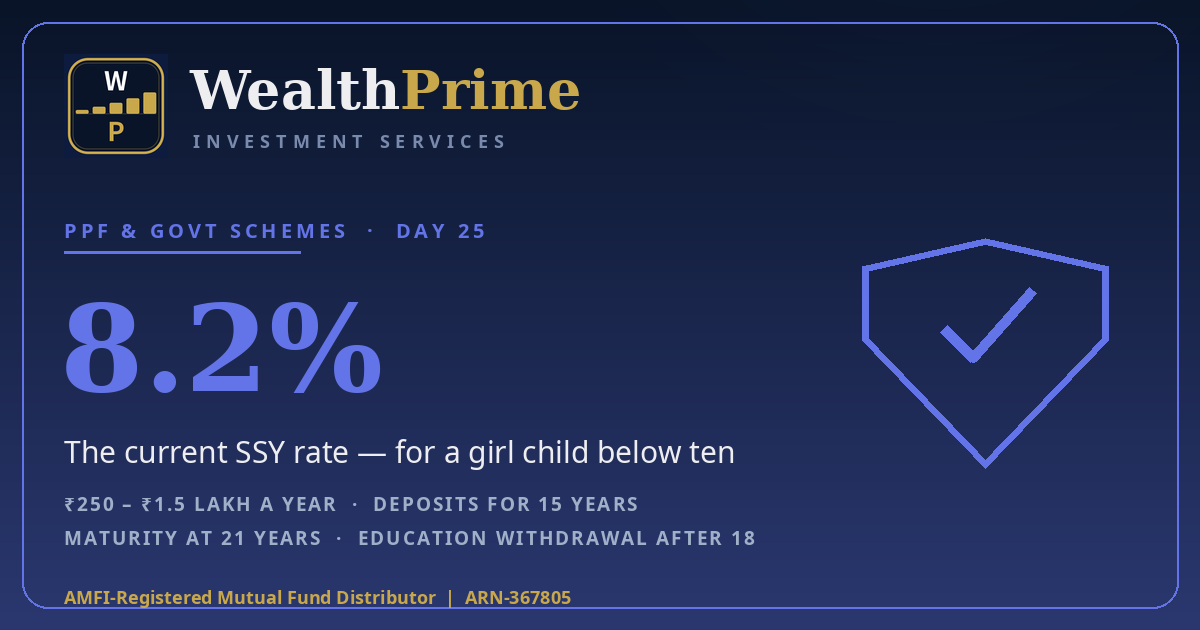
A daughter is born, the family celebrates, and within weeks a relative asks the question that starts a twenty-one-year commitment: have you opened a Sukanya Samriddhi account for her yet? The Sukanya Samriddhi Yojana, usually shortened to SSY, is the Government of India’s small savings scheme for a girl child, launched in January 2015 under the Beti Bachao, Beti Padhao initiative.
A guardian deposits for fifteen years, the account matures after twenty-one years, and firm rules govern who can open it, how much can go in, and when money can come out. This guide sets out those rules, works through the arithmetic at the current 8.2% rate, and places the SSY beside a children’s mutual fund.
Who can open an SSY account, and where the account is opened
A natural or legal guardian may open an SSY account in the name of a girl child who has not yet completed ten years of age on the date the account is opened. The age condition is strict: a girl who has already turned ten is no longer eligible, and the scheme provides no general grace period. The account belongs to the girl child, and the guardian operates the account until the girl attains eighteen years of age, after which the account holder operates the account herself.
Only one SSY account may be opened for any one girl child, anywhere in India. A family may normally open accounts for a maximum of two girl children. A narrow exception allows more than two accounts for twin or triplet girls in the first or second birth order. The account may be opened at a post office or an authorised bank, and can be transferred within India.
The opening paperwork is the girl child’s birth certificate, the guardian’s identity and address documents, and the scheme’s account-opening form. A family that already holds an account for the same child elsewhere should transfer that account rather than open a second one.
Deposits: ₹250 to ₹1.5 lakh a year, for fifteen years
An SSY account opens with a minimum initial deposit of ₹250. In each financial year the guardian must deposit at least ₹250 and may deposit at most ₹1,50,000, in multiples of ₹50, in one lump sum or in several instalments; the scheme sets no limit on the number of instalments in a year. Deposits may be made for fifteen years from the date the account is opened. After the fifteenth year the deposit window closes, and the balance continues to earn interest for the remaining six years until maturity.
An amount deposited above the ₹1.5 lakh ceiling earns no interest, and the excess may be withdrawn. Interest is calculated each month on the lowest balance between the close of the fifth day and month-end, compounded and credited at each financial year-end. A deposit made on or before the 5th therefore earns interest for that full month.
An account in which the ₹250 yearly minimum is not deposited falls into default. The guardian may revive a defaulted account before the fifteen-year deposit period ends by paying a penalty of ₹50 for each year of default together with the missed minimum deposits.
| SSY rule | What the rule says | When it applies |
|---|---|---|
| Eligibility | One account for a girl child below ten years of age, opened and operated by a guardian until the holder turns 18; normally a maximum of two accounts per family | At opening |
| Yearly deposit | Minimum ₹250; maximum ₹1,50,000, in multiples of ₹50 | Each financial year, for 15 years from opening |
| Interest | 8.2% a year at present, set by the Government each quarter; calculated monthly on the lowest balance between the 5th and month-end, credited yearly | Rate for October–December 2026 |
| Education withdrawal | Up to 50% of the balance at the end of the preceding financial year, for higher education, with fee documents | After the holder turns 18 or passes the 10th standard, whichever is earlier |
| Maturity | 21 years from the date of opening, or on the holder’s marriage after she turns 18, whichever is earlier | At maturity |
Source: Sukanya Samriddhi Account Scheme, 2019, as notified by the Ministry of Finance, and the small savings interest rate of 8.2% a year for SSY notified for the quarter. The Government reviews the rate each quarter and the rate can change.
The worked example: ₹50,000 a year for fifteen years at 8.2%
Take a guardian who deposits ₹50,000 at the start of each financial year for fifteen years and never withdraws. Total deposits are ₹50,000 multiplied by 15, which equals ₹7,50,000. At 8.2% a year held constant, the balance at the end of the fifteenth year is ₹14,91,996, of which interest is ₹7,41,996. The guardian then deposits nothing for six more years, and the balance compounds on its own to ₹23,94,040 at the twenty-one-year maturity, of which total interest is ₹16,44,040.
The same arithmetic at the maximum deposit shows the full size of the scheme. A guardian who deposits ₹1,50,000 at the start of each year for fifteen years deposits ₹22,50,000 in total, holds ₹44,75,989 at the end of year fifteen, and reaches ₹71,82,119 at maturity, of which interest is ₹49,32,119. Both examples illustrate at the current notified rate held constant: the Government resets the rate every quarter, so a real account earns a sequence of rates across twenty-one years and the final balance will differ. A reader can test a PPF account on the same yearly habit in the PPF calculator, and our guide to PPF account rules, deposits and extensions sets out the sister scheme’s calendar in the same order.
An SSY account asks for fifteen years of deposits and then gives compounding six deposit-free years to finish the work: at a constant illustrative 8.2%, the six quiet years add ₹27,06,130 to a maximum-deposit account, more than the family deposits in any four deposit years combined.
Getting money out: education withdrawal, marriage and maturity
Before maturity, the scheme permits one purpose-bound withdrawal. After the account holder attains eighteen years of age or passes the tenth standard, whichever happens earlier, the holder may withdraw up to 50% of the balance that stood at the end of the preceding financial year, to meet the actual fee and charges for admission to an educational institution. The withdrawal may be taken as a lump sum or in up to five yearly instalments, supported by the institution’s admission offer and fee slip.
The account matures twenty-one years from the date it was opened, or on the marriage of the account holder after she attains eighteen years, whichever happens earlier; marriage before eighteen does not mature the account. At maturity the full balance, including all credited interest, is paid to the account holder. Premature closure after five years is permitted only on specified grounds, such as a serious medical condition of the holder or guardian, the death of the guardian, or a change in residency or citizenship, each on documented proof.
The tax treatment completes the picture, stated as the rules stand on the publication date and subject to change. Deposits qualify for deduction under Section 80C, up to the shared ₹1.5 lakh basket limit, for a guardian filing under the old tax regime; the new regime does not offer the Section 80C deduction. Interest credited to the account and the maturity amount are exempt from tax, which is why the SSY is described as an EEE scheme, exempt at deposit, on interest, and at exit. Families comparing government schemes with market-linked options can compare funds across categories in the explorer alongside these rules.
SSY beside a children’s mutual fund: two different jobs
Parents often place the SSY and a mutual fund for a child’s education in a single contest, and the comparison misleads when the two products are treated as the same job. The SSY account pays a Government-notified interest rate that resets each quarter, carries sovereign backing for the deposits and interest under the scheme, locks money in until the education withdrawal window or maturity, and caps deposits at ₹1.5 lakh a year. A mutual fund for the same goal has no scheme deposit ceiling, allows deposits and withdrawals on the fund’s own terms, and returns whatever the market delivers, which can be negative over shorter periods; past performance is not indicative of future returns.
The arithmetic shows the trade-off without declaring a winner. The ₹50,000-a-year SSY example above reaches ₹23,94,040 at twenty-one years at a constant illustrative 8.2%. The same ₹50,000 at the start of each year for fifteen years, left invested for six further years at an assumed 12% a year, reaches ₹41,20,679 — an illustration, not a forecast or a promise, and a real market path would move up and down along the way rather than climb in a straight line. Many families hold both, using the SSY where certainty matters and a mutual fund where time can absorb market movement — a planning choice each family makes on its own dates and income.
Frequently asked questions
Who can open a Sukanya Samriddhi Yojana account?
A natural or legal guardian can open a Sukanya Samriddhi Yojana account in the name of a girl child who has not yet completed ten years of age on the date of opening. Only one account is permitted for any one girl child, and a family may normally open accounts for a maximum of two girl children, with a narrow exception for twin or triplet girls in the first or second birth order. The guardian operates the account until the girl turns eighteen, after which she operates it herself.
How much can I deposit in an SSY account each year?
An SSY account requires a minimum deposit of ₹250 in each financial year and permits a maximum of ₹1,50,000 in each financial year, in multiples of ₹50, in one lump sum or in several instalments. Deposits are made for fifteen years from the date the account is opened, after which no further deposits are accepted and the balance keeps earning interest until maturity. An amount deposited above the ₹1.5 lakh ceiling earns no interest.
When does an SSY account mature, and can money be withdrawn earlier?
An SSY account matures twenty-one years from the date of opening, or on the account holder's marriage after she turns eighteen, whichever is earlier. Before maturity, after the holder turns eighteen or passes the tenth standard, whichever is earlier, up to 50% of the balance at the end of the preceding financial year may be withdrawn for higher education, against the institution's admission and fee documents, in a lump sum or in up to five yearly instalments.
What is the SSY interest rate and tax treatment?
The SSY interest rate is 8.2% a year for October–December 2026, as notified by the Government, which reviews small savings rates every quarter, so the rate can change during the account's life. Interest is calculated monthly on the lowest balance between the close of the fifth day and month-end and is credited yearly. Deposits qualify for the Section 80C deduction up to the shared ₹1.5 lakh limit under the old tax regime, and interest and the maturity amount are exempt from tax, as the rules stand on the publication date.
The bottom line
An SSY account is a twenty-one-year structure with a fifteen-year deposit habit inside it: open the account before the girl turns ten, deposit ₹250 to ₹1.5 lakh a year in multiples of ₹50, expect one education withdrawal window after eighteen or the tenth standard, and plan for maturity at twenty-one years or on marriage after eighteen. A family that writes those four dates down on the day the account opens will use the scheme exactly as the scheme was designed.
Sources: Sukanya Samriddhi Account Scheme, 2019 (Ministry of Finance) for eligibility, deposit limits, default and revival, withdrawal, premature closure and maturity provisions; the small savings interest rate of 8.2% a year for SSY as notified by the Ministry of Finance for October–December 2026. All ₹ balances are the author’s calculations at a constant illustrative 8.2% a year — ₹50,000 a year for 15 years reaching ₹23,94,040 at 21 years, and ₹1,50,000 a year reaching ₹71,82,119 — and the mutual fund comparison uses an assumed 12% a year as an illustration only. The notified rate is reset each quarter and a real account will earn a sequence of rates. Tax rules are stated as they stand on the publication date and can change.
Planning for Your Daughter's Education?
SSY dates, deposit ceilings and the education withdrawal window decide what the account can fund — and what needs a second plan beside it. Talk to us on a free, no-pressure call about your child's education goal.
Prefer chat? WhatsApp us