Ritu, a 29-year-old marketing executive in Bengaluru, earns ₹80,000 a month and had been running a ₹10,000 monthly SIP for two years when her company announced layoffs. She found a new job within six weeks — but in between, rent, groceries and a loan EMI still had to be paid, and with no cash buffer she paid them on a credit card. The SIP she was proud of kept running; the month that tested her had nothing to do with the market.
That month is what an emergency fund is for. An emergency fund is cash kept aside, in a place you can reach instantly, for expenses that arrive without warning: a job loss, a hospital bill, an urgent repair. This article explains how much to keep (three to six months of essential expenses), the order in which to build it, where to park it, and what counts as a genuine emergency.
How much is enough? The three-to-six-month rule
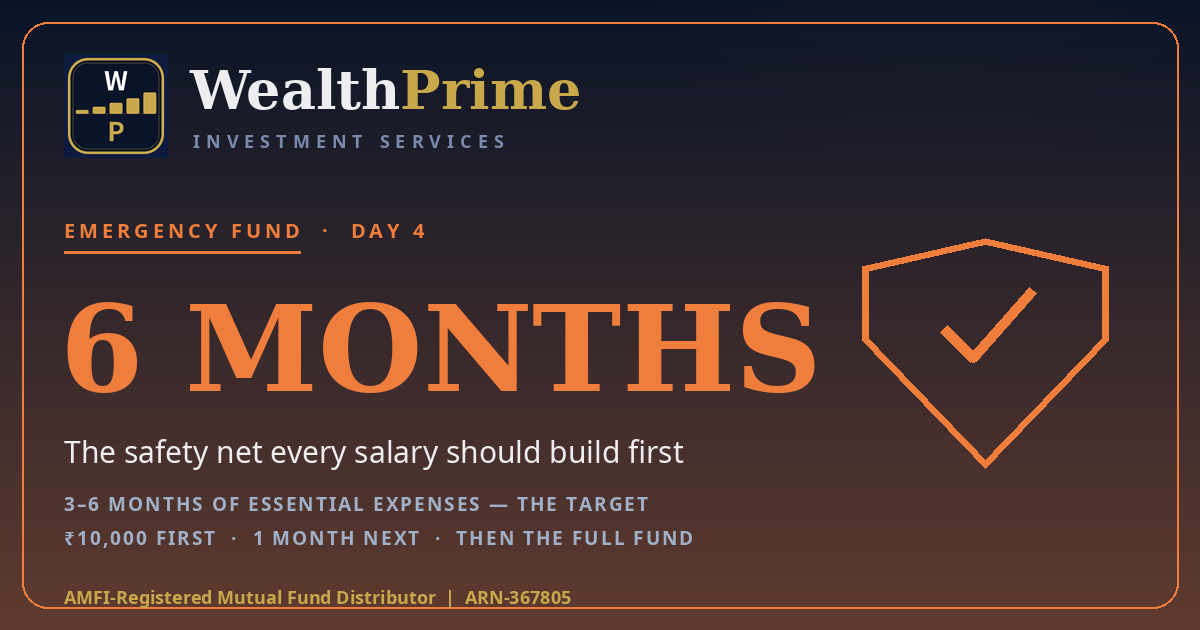
The standard rule is simple: keep three to six months of essential monthly expenses — not your salary, and not your total spending. Essential expenses are the bills that do not stop when income does: rent, groceries, utilities, transport, insurance premiums and loan EMIs. Restaurant meals, subscriptions and shopping are spending, not essentials, and counting them inflates the target until it feels unreachable.
Which end of the range fits depends on how steady the income is. Three months can be enough for a household with two incomes, a stable job and no dependants. Six months — or more — fits a single-income household, a sole earner supporting dependants, someone with a large EMI, or anyone whose income varies month to month, such as a freelancer. The more of your income that could stop at once, the larger the buffer needs to be.
Take Ritu's numbers as the worked example for this article. Her essential monthly expenses are ₹45,000: rent ₹18,000, groceries and food ₹12,000, transport ₹5,000, utilities and phone ₹4,000, and loan EMIs and insurance ₹6,000. That adds up to ₹45,000 a month. Three months of expenses is therefore ₹1,35,000, and six months is ₹2,70,000. Those two figures — ₹1,35,000 and ₹2,70,000 — are the range this article's build plan works toward.
The build order: ₹10,000 first, then one month, then the full fund
A ₹2,70,000 target can paralyse the very person who needs it most, so the build order matters as much as the target. Build it in three stages, and celebrate each one.
Stage 1: a ₹10,000 starter buffer. Ten thousand rupees will not cover a job loss, but it covers the small shocks that otherwise go on a credit card: a phone repair, a medical test, a sudden travel need. Getting to ₹10,000 quickly proves the habit works, and a habit that works gets repeated.
Stage 2: one full month of essential expenses. For Ritu, that is ₹45,000. One month of breathing room changes the maths of a crisis completely: it buys time to find work or arrange help without borrowing at credit-card interest rates.
Stage 3: the full three-to-six-month fund. Only now does the target become ₹1,35,000 to ₹2,70,000 — built gradually, from money already being saved every month.
Now the timeline. Suppose Ritu sets aside ₹15,000 a month from her salary for the fund. She crosses the ₹10,000 starter buffer during month one. After three months she has saved ₹45,000 — one full month of expenses. After nine months she has ₹1,35,000 — three months covered. After eighteen months she has ₹2,70,000 — the full six-month fund. The arithmetic is plain multiplication (₹15,000 × 18 = ₹2,70,000), and it shows why the habit matters more than the amount: any fixed monthly sum reaches the target eventually. Saving ₹7,500 a month instead would simply double each timeline — 36 months to the full ₹2,70,000 — while saving ₹22,500 a month would cut it to 12 months.
One practical detail makes the plan easier to keep: automate the transfer for salary day, so the emergency-fund money leaves the account before spending starts. A fund built from "whatever is left at month-end" is a fund that rarely gets built, because month-end leftovers are usually zero.
Where to park it: instant access beats higher returns
An emergency fund has one job — being there, in full, on the day it is needed. That rules out anything whose value can fall sharply or that takes days to sell. Three parking places are commonly used, and many households split the fund between two of them:
| Where | Access | Return note | Watch out |
|---|---|---|---|
| Savings account | Instant, any hour, including weekends | Modest interest; deposits insured up to ₹5 lakh per depositor per bank under DICGC | Easy to spend — keep it in a separate account from daily spending |
| Sweep-in fixed deposit | Instant — the bank breaks the deposit automatically when the account needs it | FD-like interest on the swept amount, higher than a plain savings account | Sweep thresholds and break rules vary by bank; read them before relying on the facility |
| Liquid mutual fund | Usually the next working day; SEBI's instant-redemption facility allows up to ₹50,000 a day | Returns vary with the market and are not fixed; the value can dip slightly | An exit load applies to redemptions in the first seven days under SEBI's graded structure |
A common split is one month of expenses in a savings account — the money needed within hours — and the rest in a sweep-in FD or a liquid fund, where it earns a little more while staying reachable within a day. What matters is not squeezing the highest return from the fund; the return on an emergency fund is almost irrelevant next to its purpose. A fund that earns 1% more but cannot be withdrawn on a Sunday night has failed at its only job.
What the fund should never be parked in is equity: shares and equity mutual funds can fall 20% or more in a bad month, which is precisely when job losses and emergencies cluster. The emergency fund is the money that protects the SIP, not money that competes with it. Readers who want to see how a fixed deposit grows can test the numbers on our FD calculator, and readers comparing fund categories can browse them factually in our fund explorer.
An emergency fund is not money sitting idle — it is the reason a job loss or a hospital bill never becomes a credit-card balance or a forced SIP redemption. Build it in order: ₹10,000 first, one month next, then the full three to six months of essential expenses.
What counts as an emergency — and what does not
A fund with no rules gets spent on non-emergencies, so define the word before the money is needed. A genuine emergency is unexpected, necessary and urgent — all three at once. A job loss qualifies. A hospital bill qualifies. An urgent home or vehicle repair that cannot wait qualifies. A family emergency requiring travel qualifies.
What does not qualify, however tempting: a festival sale, a new phone while the old one works, a vacation, a "once-in-a-lifetime" investment opportunity, or a friend's business idea. None of those is unexpected in the way a crisis is, and none is urgent in the way a hospital bill is. Raiding the fund for a sale item is not an emergency — it is the fund doing the job of a shopping budget, and it leaves nothing for the real crisis that follows.
One grey area deserves a clear rule: a predictable large expense, such as annual insurance premiums or a planned car service, is not an emergency either. Those belong in a separate sinking fund — a small monthly set-aside for known yearly bills — so they never need to touch the emergency fund at all.
After you use it: refill first, then resume the plan
Using the emergency fund is not failure — it is the fund working exactly as designed. The discipline comes after: refill it before increasing discretionary spending or starting new investments. The refill follows the same order as the build — starter buffer first, then one month, then the full fund — because the same small-shock protection matters again immediately.
Two maintenance habits keep the fund honest over the years. First, keep it visibly separate — a different account, or a clearly labelled liquid-fund folio — so a glance at the main account never mistakes it for spending money. Second, review the target once a year: when rent rises or a new EMI begins, essential expenses rise with them, and a fund sized for last year's expenses is quietly too small. Recompute the target from current expenses, and top it up to match.
Once the fund is in place, the rest of the financial plan gets easier: SIPs can run without the fear that a bad month will force a redemption, and that confidence is worth more than any return the buffer itself earns. If you have not started investing yet, our guide on how to start a SIP in India walks through KYC, fund selection and automation, step by step.
Frequently asked questions
How much emergency fund do I need in India?
Three to six months of your essential monthly expenses — rent, groceries, utilities, transport, insurance premiums and loan EMIs. Households with two incomes and stable jobs can aim for the three-month end; single-income households, sole earners with dependants, and people with variable incomes should aim for six months or more. Start with a ₹10,000 starter buffer, then build to one full month, then to the full target.
Should I invest my emergency fund in equity mutual funds or stocks?
No. Equity values can fall sharply, often at the same time as job losses and other emergencies, so money invested in equity may be worth much less on the day it is needed. Emergency money belongs in places where its value stays stable and it can be withdrawn quickly: a savings account, a sweep-in fixed deposit, or a liquid fund.
Savings account or liquid fund — which is better for emergency money?
Both have a role. A savings account gives instant access at any hour, so it suits the first month of expenses. A liquid fund usually redeems on the next working day, with SEBI's instant-redemption facility allowing up to ₹50,000 a day, and typically earns more than a savings account — but its returns vary and are not fixed. A common approach is to keep one month in savings and the rest in a sweep-in FD or a liquid fund.
I used my emergency fund — what do I do now?
Treat refilling it as the first financial priority, ahead of new investments or higher discretionary spending. Refill in the same order as the original build: the ₹10,000 starter buffer first, then one month of expenses, then the full three-to-six-month target. Review the target at the same time, since the expense that drained the fund may have changed your monthly essentials.
The bottom line
An emergency fund is the least glamorous and most useful money a salaried household owns. Size it from essential expenses, not salary: three months (₹1,35,000 on ₹45,000 of monthly essentials) at the cautious end for stable dual-income households, six months (₹2,70,000) for single incomes and variable earnings. Build it in order — ₹10,000 first, one month next, then the full fund — park it where it can be reached within a day, spend it only on the unexpected, necessary and urgent, and refill it before anything else after use. Do that, and the next bad month becomes an inconvenience instead of a debt.
Sources: DICGC deposit insurance limit of ₹5 lakh per depositor per bank; SEBI's instant-redemption facility for liquid and overnight funds (up to ₹50,000 per day) and graded exit-load structure for liquid funds; the worked figures are the author's own calculations from the stated expense and savings assumptions.
Your Safety Net Comes Before Your SIP
An emergency fund is the foundation every SIP should stand on. Talk to us on a free, no-pressure call about building yours — then starting your SIP with confidence.
Prefer chat? WhatsApp us