Priya started her first job in 2026 earning ₹45,000 a month, and began a ₹5,000 monthly SIP. Five years later she earns far more than she did at the start — but her SIP is still exactly ₹5,000. Her income grew; her investing did not. That gap between a rising salary and a fixed SIP is the problem a step-up SIP is designed to close.
A step-up SIP — also called a top-up SIP — is an ordinary SIP with one extra instruction: raise the monthly amount by a fixed percentage or a fixed rupee amount every year, usually on the SIP's anniversary. This article explains how a step-up SIP works, shows the 20-year arithmetic for a flat ₹5,000 SIP against a 10% yearly step-up, covers how to set one up, and lists the mistakes that most often undo the habit.
What a step-up SIP actually is
A regular SIP invests the same amount every month. A step-up SIP starts the same way, but the amount increases on a schedule chosen at the start: a percentage step-up (for example, 10% more each year) or a fixed-amount step-up (such as ₹500 more each year).
With a 10% yearly step-up on a ₹5,000 SIP, the monthly amount becomes ₹5,500 in year two and ₹6,050 in year three; by year ten it is about ₹11,790, and by year twenty about ₹30,580. The investor does not need to remember to increase anything: the increase happens automatically on each anniversary, unless the investor changes or cancels the instruction.
The money still goes into the same mutual fund scheme, units are still bought at the scheme's NAV on each instalment date, and the investor can still pause, modify or stop the SIP. A step-up is not a different product from a SIP — it is a SIP with a built-in annual raise.
Two details are worth knowing before choosing the step-up rate. Most fund houses and platforms cap the step-up amount or the number of step-up years, so the exact options depend on where the SIP is registered. And a step-up instruction applies to the SIP's amount only; it does not change the scheme, the SIP date or the bank mandate unless the investor changes those separately.
The worked example: flat ₹5,000 vs a 10% yearly step-up over 20 years
Two investors each start a monthly SIP and keep it running for 20 years (240 instalments). Both earn the same return. The only difference is that one keeps the SIP flat at ₹5,000 a month, while the other raises it by 10% every year.
The assumptions are stated plainly so the arithmetic can be checked: returns are assumed at 12% per year, compounded monthly (1% per month), with each instalment invested at the start of the month. That 12% figure is an assumption made for this illustration only — it is not a forecast, not a promise, and not a guarantee of what any fund will earn. Actual mutual fund returns vary with the market, and past performance is not indicative of future returns.
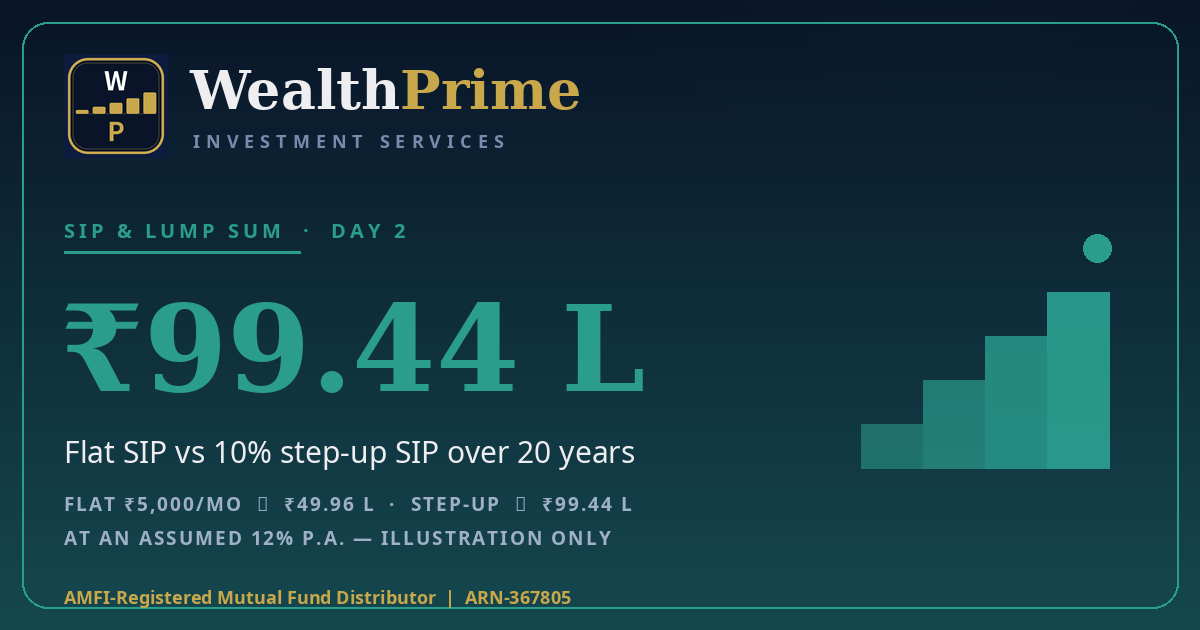
Three things stand out. First, the step-up investor ends with roughly double the flat SIP's value — ₹99,44,358 against ₹49,95,740. Second, the step-up investor also invested far more in total: ₹34,36,500 against ₹12,00,000, an extra ₹22,36,500. The step-up did not create money from nothing; it channelled a rising income into investing. Third, the extra value (₹49,48,618) is more than double the extra amount invested, because the larger later instalments still had years left to compound, while the earliest instalments had the full 20 years.
That answers the most common objection — "the later instalments have less time to grow, so do they matter?" They matter because they are much larger. By year twenty, the step-up investor is investing about ₹30,580 a month, six times the starting amount, and even a few years of compounding on instalments of that size adds up quickly.
The table below shows how the monthly amount grows under a 10% yearly step-up:
| Year of SIP | Monthly SIP amount | What has changed |
|---|---|---|
| Year 1 | ₹5,000 | Starting amount |
| Year 5 | ₹7,321 | Four annual increases of 10% |
| Year 10 | ₹11,790 | More than double the starting amount |
| Year 15 | ₹18,987 | Nearly four times the starting amount |
| Year 20 | ₹30,580 | About six times the starting amount |
Readers can test their own starting amount and step-up rate on our SIP calculator, which shows how a monthly SIP grows year by year at a return the reader chooses.
Why step-ups work: salary, inflation and behaviour
A step-up SIP works for three separate reasons.
It matches investing to income. Most salaried investors get an annual increment, often in the range of 8–12%. If investing stays flat while income rises, the share of income being invested quietly falls every year. A step-up set near the increment rate keeps the habit proportional to income instead of letting lifestyle spending absorb every raise: when the salary letter arrives, the SIP increase for that year is already decided.
It offsets inflation. A ₹5,000 monthly investment made in 2026 will not buy the same basket of goods and services in 2046 if prices rise in between, so a fixed SIP slowly becomes a smaller real commitment even though the number on the statement never changes. Raising the SIP each year keeps the real size of the habit closer to constant — a point that matters most for goals decades away, such as retirement.
It removes a decision. Raising a SIP manually requires the investor to remember, log in, and act — three chances to postpone. An automatic increase happens before the extra money reaches the spending account, so the decision is made once and the habit runs on its own.
None of this makes a step-up SIP a higher-return product. The fund, the market and the investor's holding period decide returns. A step-up changes only how much is invested, and when — and over long periods, how much is invested matters at least as much as the return earned on it.
How to set up a step-up SIP
Setting up a step-up SIP follows the same path as starting any SIP, with one extra choice at the start. The broad steps, which vary slightly by platform, are:
- Complete KYC and pick the scheme — the same first steps as any SIP, covered in our guide on how to start a SIP in India. The scheme choice comes first; the step-up is an instruction on the SIP, not a feature of the scheme.
- Choose the starting amount and the SIP date — many investors align the SIP date with salary credit, so the money leaves the account before spending starts.
- Select the step-up option — on the registration form, look for "step-up", "top-up" or "increase SIP" and choose a percentage (for example 10% yearly) or a fixed amount (for example ₹500 yearly). Note the platform's cap, since a very high percentage can hit it in later years.
- Set the bank mandate high enough — the mandate must cover the largest future instalment, not just the first one. A mandate set at exactly ₹5,000 will fail once the SIP steps up beyond that figure.
- Review once a year — when the salary increment arrives, check that the stepped-up amount still fits the monthly budget and that the goal and time horizon have not changed.
Investors who already run a flat SIP can usually add a step-up to it, or start a second SIP with the step-up instruction — the route depends on the platform. Either way, the existing SIP's units and holding periods are unaffected by adding a step-up instruction to future instalments.
For readers comparing fund categories before starting, our fund explorer lists equity fund categories side by side with expense ratios and fund details, so the scheme decision can be made on facts rather than on headlines.
A step-up SIP is not a cleverer fund — it is a salary-linked habit. A 10% yearly step-up on a ₹5,000 SIP turns ₹12 lakh invested into ₹34.36 lakh invested over 20 years, and, at an assumed 12% p.a. for illustration, turns ₹49.96 lakh of value into ₹99.44 lakh.
Five step-up mistakes to avoid
1. Setting the step-up higher than salary growth. A 20% yearly step-up sounds ambitious, but if salary grows at 8%, the SIP will eventually squeeze the monthly budget and get cancelled. A step-up that survives is worth more than an ambitious one that stops in year four.
2. Forgetting the bank mandate. This is the most common administrative failure with step-up SIPs: the mandate limit covers the first instalment but not the stepped-up ones, so debits start failing years later.
3. Stepping up a SIP that no longer fits the goal. A step-up amplifies whatever the SIP is doing — including investing in a fund category that no longer matches the goal's time horizon. Check the goal first and the amount second at the annual review.
4. Treating the step-up as a substitute for starting early. A step-up helps most when it runs for many years, because the largest instalments arrive late. Starting one five years before a goal will not reproduce the 20-year arithmetic above; time, not the step-up alone, does the heavy lifting.
5. Cutting the SIP at the first market fall. Step-up SIPs are most often abandoned during corrections, when the stepped-up amount feels largest. The arithmetic above assumes every instalment was invested, including instalments made during falling markets — when a fixed monthly amount buys more units.
Frequently asked questions
What is a step-up SIP?
A step-up SIP, also called a top-up SIP, is a regular systematic investment plan in which the monthly investment amount increases automatically by a fixed percentage or a fixed rupee amount every year. The investor chooses the increase rate at the start, and the higher amount applies from each SIP anniversary until the investor changes or cancels the instruction.
Is a step-up SIP better than a normal SIP?
A step-up SIP is not a different or higher-returning product — it invests in the same fund as a normal SIP. The difference is only the amount invested over time: a step-up SIP invests more as income rises, so over long periods it can build a larger corpus than a flat SIP at the same return. Whether that suits an investor depends on whether their income is actually rising and whether the higher future amounts fit their budget.
What step-up percentage should I choose?
There is no single right percentage. A common starting point is to match the step-up rate to the investor's expected annual salary increment, often around 8–10% for salaried investors, so the SIP grows at roughly the same pace as income. A percentage far above salary growth risks making the SIP unaffordable in later years, while a very small step-up barely changes the outcome.
Can I pause or change a step-up SIP later?
Yes. A step-up SIP can be paused, modified or stopped in the same way as a regular SIP, through the fund house or the platform where it is registered. Changing the step-up rate, the amount or the SIP date usually takes effect from the next instalment cycle, and stopping the SIP does not affect the units already purchased.
The bottom line
A flat SIP is a fine habit; a step-up SIP is the same habit kept in step with a rising income. The 20-year illustration shows the scale of the difference — ₹49,95,740 against ₹99,44,358 at an assumed 12% p.a. — but the mechanism is unglamorous: invest a little more each year, automatically, and let time do the rest. Set the step-up near your increment rate, register a mandate that covers the future amounts, and review the SIP once a year.
Sources: SIP and step-up (top-up) mechanics as described in scheme information documents and fund-house SIP registration forms; the 20-year figures are the author's own illustrative calculation at an assumed 12% p.a. compounded monthly, stated in the article, and are not scheme data or a forecast.
Make Your Next Raise Work for You
A step-up SIP turns salary hikes into wealth automatically. Talk to us on a free, no-pressure call about setting one up for your goals.
Prefer chat? WhatsApp us