Two colleagues start investing on the same day, with the same amount of money. Fifteen years later, one has noticeably more wealth than the other — not because she picked luckier stocks, but because her fund charged her less every single year. That quiet difference sits at the heart of the index funds vs active funds debate.
An index fund and an actively managed fund are the two basic styles of mutual fund investing in India: one follows a rule-book, the other follows a fund manager. This article explains how each style is run, what the cost gap between them does over 15 years, and how to read a benchmark and tracking error — then, instead of declaring a winner, ends with a four-question framework for deciding which style fits your goal.
How each fund is run: a rule-book vs a fund manager
An index fund copies an index: a fund that tracks the Nifty 50 buys the same 50 companies, in roughly the same proportions, as the index itself. SEBI requires an index fund to invest at least 95% of its money in the securities of the index it tracks, so the manager of an index fund has almost no freedom to pick different stocks. When the index provider changes the index's list, the fund changes its holdings to match.
An actively managed fund works the opposite way. A fund manager and research team study companies and deliberately choose which stocks to buy, which to avoid, and how much of each to hold. The manager of an active fund still works inside guardrails: SEBI's category rules say, for example, that a large-cap fund must invest at least 80% of its money in India's top 100 companies by market value. Within those guardrails, the manager's judgement — not a rule-book — decides the portfolio.
| Feature | Index fund | Actively managed fund |
|---|---|---|
| How stocks are chosen | The fund copies the index's list of companies, in the index's proportions | The fund manager and research team pick stocks within the fund's SEBI category |
| Role of the benchmark | The benchmark is the product — the fund's job is to match it closely | The benchmark is the yardstick — the fund's job is to beat it after costs |
| Typical total expense ratio (regular plan) | Commonly 0.2%–0.5% for large index funds; SEBI caps index funds at 1% | Commonly 1%–2% for equity funds; exact figure in the factsheet |
| What the holdings are | The index's holdings, which anyone can look up | The manager's chosen holdings, disclosed in the monthly factsheet |
| When the portfolio changes | Mainly when the index itself changes its list | Whenever the manager's view changes, within the category rules |
Neither structure is a trick: the index fund sells you the market's own return minus a small fee; the actively managed fund charges more for a chance — never a promise — of beating the market.
The expense-ratio gap: what 1.2% a year does over 15 years
Every mutual fund charges an expense ratio: the yearly fee, expressed as a percentage of your investment, that pays for running the fund. Because an index fund needs no stock-picking research team, its expense ratio is usually far lower. The fee levels used below — 0.30% and 1.50% — sit inside the ranges large funds actually disclose in their factsheets today.
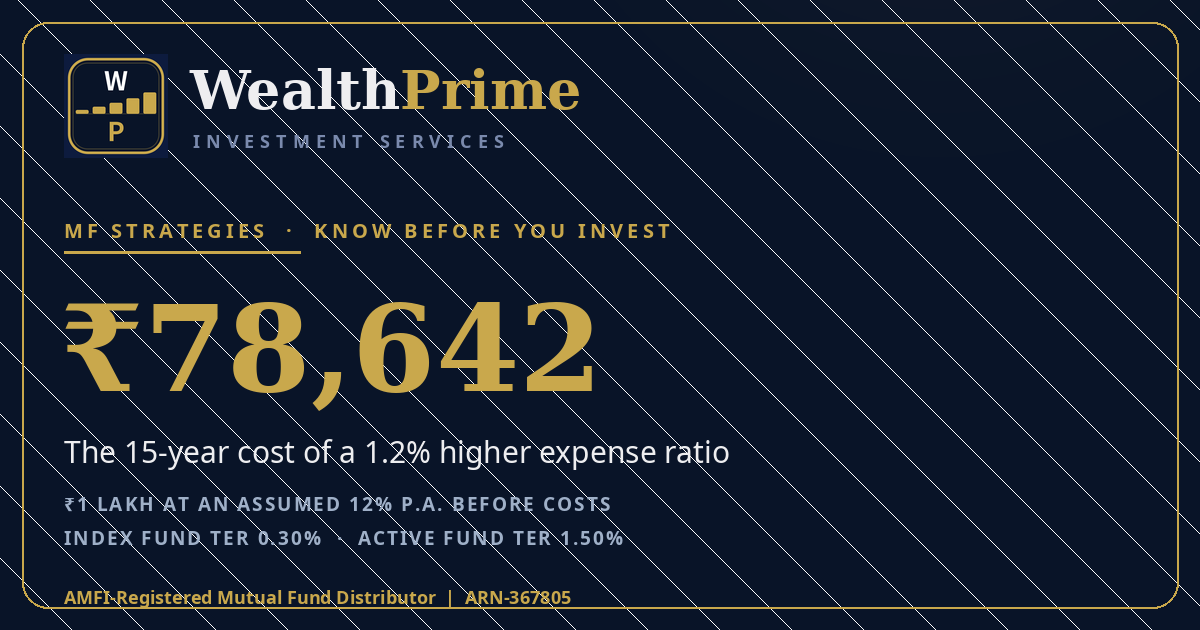
Now put real numbers on the gap. Imagine a lump sum of ₹1,00,000 invested for 15 years. To isolate the effect of cost alone, assume both portfolios earn exactly 12% a year before expenses — an assumption made only for this illustration, not a forecast or a guarantee of what any fund will earn. The index fund charges 0.30% a year, so its return after costs is 11.70%. The actively managed fund charges 1.50% a year, so its return after costs is 10.50%.
Why does the gap grow so large when the yearly fee gap is "only" 1.2%? The fee is charged on your whole growing corpus, every year. By year fifteen, 1.2% of a ₹4–5 lakh corpus is a large sum — and every rupee that leaves as a fee is a rupee that stops compounding for you.
One honest counterpoint belongs here: the example deliberately gives both portfolios the same return before costs. A skilled active manager who earns more than 1.2% a year extra before costs would erase the fee gap entirely — and some managers do achieve that in some periods. The asymmetry is that the fee is certain, while the extra return is not. The active fund starts every year 1.2% behind, and must first earn that much extra just to draw level.
You can test the same idea with your own numbers on our lump sum calculator, which shows how a lump sum grows year by year at a return you choose.
Costs are the one part of your return that you can know in advance. A 1.2% yearly fee gap, on its own, can quietly take ₹78,642 out of a ₹1 lakh investment over 15 years — before any question of stock-picking skill even arises.
Benchmarks and tracking error: the two report cards
Every equity fund declares a benchmark — the index against which the fund's performance is measured. Since February 2018, SEBI has required equity funds to use the total return variant of the benchmark index, which counts dividends as well as price gains. A price-only benchmark would flatter the fund; the total return variant does not.
For an actively managed fund, the benchmark is the yardstick the manager is trying to beat. If a flexi-cap fund's benchmark returned 14% over a year and the fund returned 12.5% after costs, the manager lagged the yardstick that year. For an index fund, the benchmark is the product itself: the fund's job is to copy it as closely as possible, not to beat it.
Index funds are therefore judged by tracking difference and tracking error. The tracking difference is the gap between the fund's return and the index's return over a period — for a well-run index fund, that gap usually stays close to the fund's expense ratio. The tracking error measures how consistently the fund hugs the index; a lower tracking error means the fund's returns have stayed closer to the index's returns. Both figures appear in the fund's monthly factsheet; a persistently wide tracking difference means the fund is, in effect, costing more than its stated fee.
You do not need twenty factsheets to compare these facts: our fund explorer lists index funds alongside actively managed funds, and every fund's page shows its expense ratio, benchmark and category in one place, so comparing index funds against active funds in the same category takes minutes.
When each style tends to fit a goal
Neither style wins in all conditions, so the more useful question is: which style fits this goal, this time horizon, and this investor's temperament? A few patterns are worth knowing — stated as tendencies, since markets have rewarded and punished both styles in different periods, and past performance is not indicative of future returns.
- Where stock-picking room is narrow: a large-cap manager must choose from the same heavily researched top-100 companies the index already holds. Many investors therefore use low-cost index funds for a portfolio's large-cap core, where the fee gap is hardest to overcome.
- Where stock-picking room is wider: mid-cap and small-cap companies are researched less and their prices can stray further from business value — so the case for active management is that a strong research team has more room to add value there. Those segments are also more volatile, so the fee question sits alongside a bigger risk question.
- For hands-off investors: an index fund asks less of its investor: no manager needs monitoring and no style drift needs watching, because the fund's holdings are simply the index's holdings.
- For investors who enjoy the homework: an active fund demands periodic checking — the manager's style, performance against the total-return benchmark over rolling periods, and the expense ratio. Investors who enjoy that process sometimes accept the higher fee as the price of trying to beat the market.
A four-question framework for your decision
Instead of asking "which style is better?", run any fund — index or active — through these four questions:
- What does the fund cost? Note the expense ratio of the exact plan you are buying. Costs are certain; every return figure is an estimate.
- What is the fund's benchmark, and has the fund done its job? For an index fund, check the tracking difference. For an active fund, compare the fund's return with its total-return benchmark over 3, 5 and 10 years — one good year proves very little.
- Does the fund's category match my goal's time horizon? Equity funds of either style belong to goals that are years away. The category question comes before the index-vs-active question, not after it.
- Will I actually review the fund? If the honest answer is no, give simplicity and low cost more weight in your decision.
Plenty of Indian portfolios hold both styles — an index core with active funds around it, or the reverse. The framework matters more than the label: known and reasonable costs, a benchmark the fund is honestly measured against, and a category that matches the goal.
Frequently asked questions
Are index funds safer than actively managed funds?
No. Index funds and actively managed funds are both market-linked, so the value of both rises and falls with the market. An index fund removes one specific risk — the risk that a manager's stock picks lag the index — but an index fund fully shares the market's ups and downs. Safety depends mainly on the fund's category and your time horizon, not on which of these two styles you pick.
Why are index fund fees so much lower?
An index fund follows a fixed rule-book: the fund copies the index's list of stocks in the same proportions, so the fund does not need a large research team deciding what to buy and sell. SEBI also caps the total expense ratio of index funds at 1%. Actively managed funds employ fund managers and analyst teams, and the cost of that expertise is recovered through a higher expense ratio.
Can an actively managed fund beat an index fund?
Yes — in any given period, some actively managed funds do beat their benchmark index, sometimes by a wide margin. The difficulty for an investor is that past performance is not indicative of future returns, so yesterday's outperforming fund is not guaranteed to repeat the feat. What is certain in advance is the fee: the higher-cost fund must outperform by at least its extra fee, every year, just to match the index fund.
How can I check a fund's expense ratio, benchmark and tracking error?
Every fund's monthly factsheet lists the fund's total expense ratio and benchmark, and index funds also disclose their tracking error in the factsheet. AMFI publishes expense ratios for all schemes on its website. A fund's page in a fund explorer shows the same facts — cost, benchmark and category — in one place, so you can compare funds before you invest.
The bottom line
The difference between index funds and actively managed funds is not good versus bad — it is rule-book versus judgement, and a small, certain fee versus a larger fee charged for an uncertain extra return. Understand the cost you are paying, check the fund against its benchmark honestly, and let your goal's time horizon make the final call.
If you have not made your first investment yet, our step-by-step guide on how to start a SIP in India walks you through KYC, fund selection and automation — the style decision becomes much easier once those basics are in place.
Sources: SEBI's mutual fund categorisation and expense-ratio framework (95% index-fund rule, 1% TER cap for index funds and ETFs, total-return benchmarking since February 2018); expense ratios from scheme factsheets and AMFI's website. The 15-year figures are an illustrative calculation, not scheme data.
Index or Active — Still Deciding?
Tell us your goal and time horizon on a free, no-pressure call — we'll help you understand which fund style fits it, and how to start a SIP in minutes.
Prefer chat? WhatsApp us