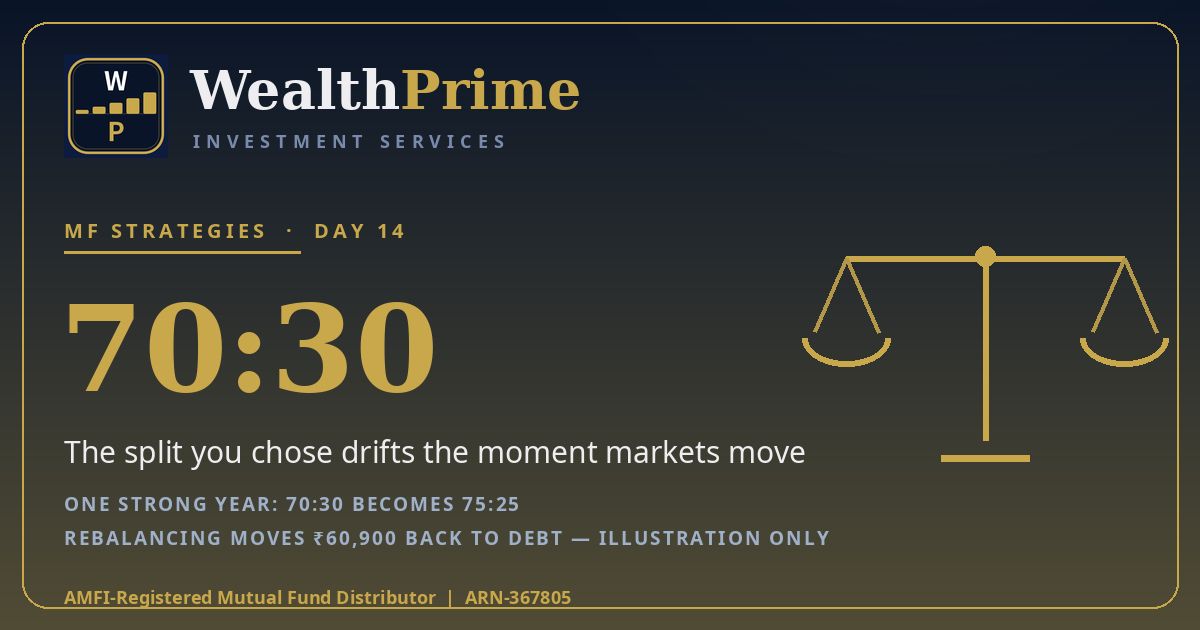
A year ago you picked a sensible split: 70% in equity funds, 30% in debt funds. You wrote it down, set up the SIPs, and got on with life — and have not bought or sold a unit since. Yet if you opened your portfolio today, that 70:30 split would be gone, replaced by something close to 75:25, without you touching anything.
That quiet movement has a name: portfolio drift. In a good year equity grows faster than debt, so the equity slice gets bigger all by itself — and with it, the risk you are actually carrying. Rebalancing is the boring habit that puts the split back where you chose it. This post shows drift in real numbers, works a ₹10 lakh example end to end, compares the two ways to decide when to rebalance, and covers the tax-smart way to do it.
What portfolio drift actually looks like
Every asset class grows at its own speed, so a fixed split never stays fixed. Equity funds in a strong year can gain 30% or more; debt funds in the same year might gain 6%. The faster-growing slice takes up more of the total, and your portfolio quietly becomes a different portfolio — with a different risk level — than the one you chose.
Take a ₹10 lakh portfolio split 70:30 — ₹7,00,000 in equity funds, ₹3,00,000 in debt funds. Now assume a strong year: equity gains 35%, debt gains 6%. These are stated assumptions for an illustration, not a forecast — real returns are never this tidy. A year later the equity funds hold ₹9,45,000 and the debt funds hold ₹3,18,000, for a total of ₹12,63,000. Equity is now 74.8% of the portfolio — the split has become roughly 75:25. You did nothing, and your risk went up anyway.
Left alone for two more years at the same assumed rates, the drift compounds: by the end of year three the equity funds hold about ₹17,22,263 and the debt funds about ₹3,57,305 — equity is 82.8% of a ₹20,79,567 total. A cautious investor who chose 70:30 is now holding roughly 83:17, the portfolio of someone far more aggressive. The risk you carry should be a decision, not an accident of which asset class ran fastest.
Drift also works the other way. In a bad year for equity, the equity slice shrinks, and you hold less equity than planned — exactly when the next recovery would reward holding more. Rebalancing cuts both ways: it trims what has run ahead and tops up what has fallen behind — selling high and buying low, on a schedule instead of a hunch. Our asset allocation guide explains how to choose the split itself; this post is about keeping it.
The worked example: rebalancing ₹10 lakh
Here is the same ₹10 lakh portfolio with the rebalance spelled out, at the same assumptions: equity gains an assumed 35% in a strong year, debt an assumed 6% — an illustration, not a forecast or a promise.
| Equity funds | Debt funds | Total | Equity share | |
|---|---|---|---|---|
| At the start | ₹7,00,000 | ₹3,00,000 | ₹10,00,000 | 70% |
| After one strong year | ₹9,45,000 | ₹3,18,000 | ₹12,63,000 | 75% |
| After rebalancing | ₹8,84,100 | ₹3,78,900 | ₹12,63,000 | 70% |
The rebalance itself is one instruction: switch ₹60,900 from the equity fund into the debt fund, and the portfolio is 70:30 again — ₹8,84,100 in equity, ₹3,78,900 in debt. The funds have not changed; only the proportions are back where you chose them.
Now the part that justifies the habit. Suppose the next year is a bad one: equity falls 20%, debt earns its steady 6%. The rebalanced portfolio ends the year at ₹11,08,914 — equity ₹7,07,280, debt ₹4,01,634. The portfolio left to drift ends at ₹10,93,080 — equity ₹7,56,000, debt ₹3,37,080. The rebalanced portfolio is ₹15,834 ahead, not because rebalancing predicts falls, but because it had moved money into the asset that did not fall. After the fall it holds 63.8% in equity against 69.2% for the drifted one — so the next rebalance would move money back into equity, buying low, exactly when it feels hardest.
And the honest counterpoint, because rebalancing is not a free lunch: if equity bounces straight back the year after — up 35% again, debt up 6% — the rebalanced portfolio ends at ₹13,80,560 against ₹13,77,905 for the drifted one, still ₹2,655 ahead in this example, because the larger debt cushion kept earning its steady return. Rebalancing is a risk decision first and a return decision a distant second; even when it costs a little in a roaring market, that is the price of the risk level you chose.
Calendar vs threshold: two ways to decide when
Calendar rebalancing means picking a date and sticking to it: every 1 April, every birthday, the same day you file your taxes. Once a year is enough for most portfolios. Its strength is that it needs no judgement — the date arrives, you check the split, you act if it has moved. Its weakness is that it can act on a small drift that barely matters.
Threshold rebalancing means acting only when a slice moves a set distance from its target — the common rule is 5 percentage points, so a 70% equity target triggers a rebalance at 75% or 65%. In our worked year the portfolio ended at 74.8% equity — a whisker short of the trigger — so a threshold investor would have waited a few weeks longer. Its strength is that every rebalance is meaningful; its weakness is that you have to watch for the trigger.
For most salaried investors the practical answer is a hybrid: check once a year, act only if any slice is more than 5 percentage points from target. Either method beats the common default, which is never rebalancing at all. What matters is not the method — it is that the decision is made in advance, on a rule, rather than in the middle of a market move.
How to rebalance inside mutual funds — and the tax-smart route
The mechanics are simple. Within one fund house, a switch moves money from one scheme to another in a single instruction; across fund houses, it is a redemption and a fresh purchase. If the amount is large, a Systematic Transfer Plan (STP) can move it in monthly instalments instead — our STP guide walks through how that works.
But for a salaried investor who is still accumulating, there is usually a better route that involves no selling at all: direct new money to the underweight asset. If equity has run ahead to 75%, point your next SIPs — and any bonus or lump sum — at the debt fund until the split is back to 70:30. No redemption, no tax event, no exit load. The portfolio rebalances itself out of your future contributions — the cheapest way to do it while you are still saving.
The tax note, because it matters: every switch between schemes counts as a redemption, and redemptions are taxable. For an equity fund, gains on units held over 12 months are taxed at 12.5% as long-term capital gains, above the ₹1.25 lakh annual exemption; units held 12 months or less are taxed at 20% as short-term gains. For a debt fund holding 35% or less in equity, gains are taxed at your income-tax slab rate under the post-2023 rules. A ₹60,900 rebalance creates only a small gain, so the tax is usually small — but it is real, and one more reason to try the fresh-money route first. Rules as of 13 Nov 2026 and can change; the scheme document and a tax professional are the final word for your situation. If you want to test your own figures first, the lump sum calculator runs the numbers on a one-off amount.
Five rebalancing mistakes that undo the good
Rebalancing every month. Monthly drift is noise, and monthly switches are churn — each one a taxable event and a chance to second-guess the plan. Once a year, or at a 5-point threshold, is plenty.
Rebalancing only one way. Many investors happily trim equity after a good year but refuse to buy equity back after a fall, when the rebalance would do the most good. The rule works in both directions or it does not work at all.
Rebalancing into yesterday’s winner. Moving money toward whichever fund did best last year is performance-chasing with extra steps. Rebalancing means moving money back to the target split you chose when you were thinking clearly.
Ignoring the debt side. Investors check their equity funds obsessively and forget the debt funds, then wonder why the portfolio’s cushion is thinner than planned. The debt slice is half the split; check it too. You can compare funds in the fund explorer when you are choosing where the rebalanced money should sit.
Rebalancing on headlines. A market crash, a budget, a rate decision — none of these is a rebalancing trigger. The calendar date or the 5-point band is. If a headline makes you want to rebalance, wait a week; the rule will still be there.
Rebalancing is not about earning more — it is about staying the investor you decided to be. A portfolio that drifts is not wrong; it is just no longer yours.
Frequently asked questions
How often should I rebalance my mutual fund portfolio?
Once a year is enough for most investors — pick a fixed date, check the split, and act only if any asset class is more than about 5 percentage points from its target. More often than that adds tax and churn without adding control; less often lets drift compound quietly, as the 70:30-to-83:17 example shows.
Does rebalancing mean selling my best-performing fund?
In part, yes — and that is the point. Rebalancing trims the asset class that has run ahead and tops up the one that has lagged, which is selling high and buying low done on a schedule. It feels wrong in the moment, because the winner looks like it will keep winning. The discipline is the whole product.
Is rebalancing taxable?
Yes, when it involves switching between schemes: every switch is a redemption, and the gain is taxed — 12.5% long-term above the ₹1.25 lakh annual exemption for equity funds, 20% short-term, and slab rate for debt funds under the post-2023 rules. Directing new contributions to the underweight asset rebalances without any sale, so it creates no tax event at all.
Can I rebalance without selling anything?
Yes, while you are still investing regularly. Point your SIPs and any lump sums at the underweight asset class until the split is restored. It is slower than a switch, but it costs nothing in tax or exit loads — and for most salaried investors it is all the rebalancing they need.
The bottom line
A 70:30 portfolio does not stay 70:30 by itself. One strong year at an assumed 35% for equity and 6% for debt turns it into roughly 75:25; three such years turn it into roughly 83:17 — and the risk you carry changes with it, without a single decision from you. Rebalancing is the annual habit that puts it back: moving ₹60,900 from equity to debt restores the split, and when the next year brings a 20% equity fall, the rebalanced portfolio ends ₹15,834 ahead of the one left to drift. Check once a year, act only beyond a 5-point band, and use fresh money before you sell anything. If your portfolio has not been checked in a while, you can compare funds in the fund explorer and see where your split actually stands today.
Sources: Portfolio drift and rebalancing mechanics — scheme information documents of Indian mutual fund houses and AMFI investor-education material. Tax treatment of redemptions — the post-2023 rules for equity and debt funds, and the 12.5% long-term capital gains rate above the ₹1.25 lakh annual exemption. All ₹ figures are the author’s calculations at the stated assumptions — an illustration, not a forecast or guarantee. Past performance is not indicative of future returns. Rules as of 13 Nov 2026 and can change.
Is Your Portfolio Still the One You Chose?
A portfolio drifts a little every year — and drift is how a 70:30 plan quietly becomes 83:17. Talk to us on a free, no-pressure call about a simple annual rebalancing habit that keeps your risk where you chose it.
Prefer chat? WhatsApp us