Somewhere along the way, the SIP became a promise in the Indian investor’s mind. “Start a SIP and your money will grow” — it sounds safe, it sounds certain, and it is repeated so often that many first-time investors treat it as a guarantee. It is not. A SIP is a method of investing, not a promise of returns — and in a falling market, a SIP loses money just like any other equity investment.
This post busts the myth with numbers, not opinions. You will see a worked example of a ₹5,000 monthly SIP in a falling market, the actual history of how badly Indian equities have fallen, and what a SIP genuinely does for you — which turns out to be valuable, just not what the myth claims.
Where the myth comes from
Three things feed it. First, the illustrations: almost every SIP calculator and brochure shows a smooth curve rising from left to right, because they assume one fixed return — say 12% a year — and compound it. The curve never dips, so the reader never sees a fall. Second, the time horizon: people hear about 10- and 15-year SIP returns, which have usually been healthy, and never hear about the middle years, when the same SIPs were deep in the red. Third, a simple confusion: “SIP” is a way of investing, not the investment itself. A SIP in an equity fund buys units of that fund every month. If the fund’s value falls, the SIP’s value falls. The payment schedule changes nothing about that.
Then there is the half-truth that keeps the myth alive: rupee-cost averaging. Averaging does lower your average purchase price — you buy more units when the NAV is low and fewer when it is high. That is real, and it helps. But it helps only when prices recover. Averaging alone never turns a loss into a profit; it only changes the price at which you will profit if the market comes back. The “if” is doing all the work, and the myth quietly deletes it.
A ₹5,000 SIP in a falling market — the worked example
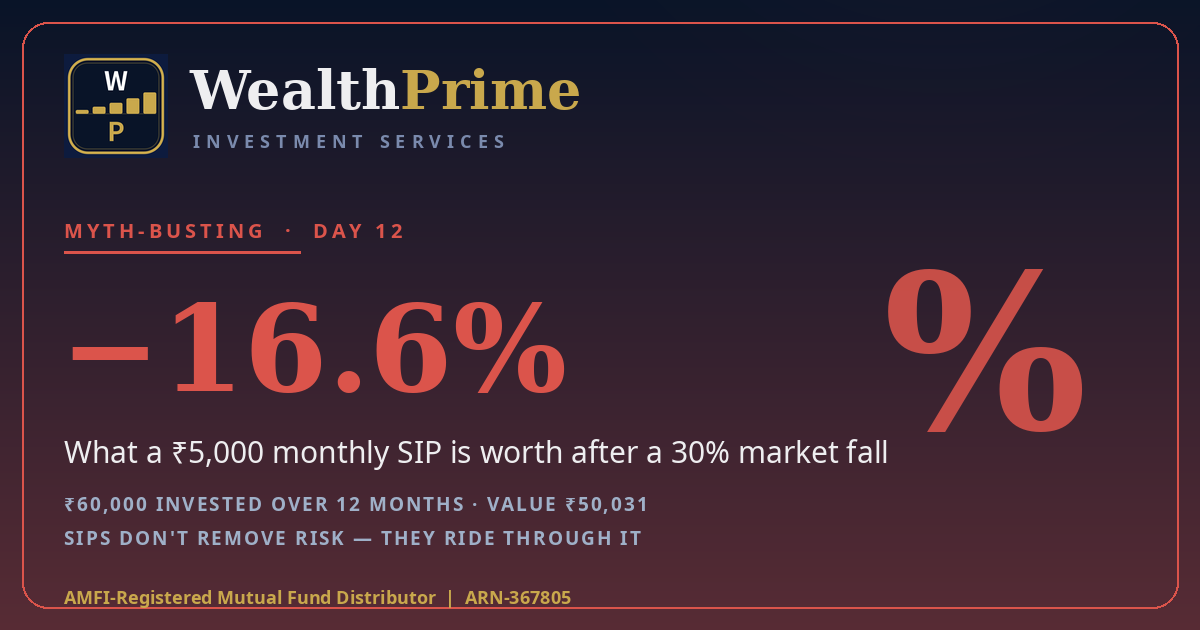
Take a ₹5,000 monthly SIP in an equity fund, running for 12 months. Assume the fund’s NAV starts at ₹100 and falls steadily to ₹70 over the year — a 30% fall, roughly the size of a bad year for Indian equities. This is an illustration with stated assumptions, not a forecast: real NAVs fall in fits and starts, not straight lines.
| Month | NAV (₹) | Units bought |
|---|---|---|
| Month 1 | 100.00 | 50.00 |
| Month 4 | 91.80 | 54.47 |
| Month 8 | 80.90 | 61.80 |
| Month 12 | 70.00 | 71.43 |
| Total (12 months) | — | 714.73 units |
Every month the same ₹5,000 bought more units than the month before — 50.00 units in month one, 71.43 in month twelve. That is rupee-cost averaging working exactly as advertised. And yet: 714.73 units at a NAV of ₹70 are worth ₹50,031. The investor put in ₹60,000 and holds ₹50,031 — a loss of ₹9,969, or 16.6%.
Two things matter in that result. First, the SIP did lose money — nearly ₹10,000 of it — even though every instalment bought more units than the one before. Cheaper units are still worth less than you paid for them until the price recovers. Second, the loss was smaller than a lump sum’s: ₹60,000 invested at once at ₹100 buys 600 units, worth ₹42,000 at ₹70 — a 30% loss. Averaging softened the fall; it did not prevent it.
Now the recovery, because this is where the SIP earns its keep. If the NAV climbs back to ₹100 — no gain at all from the starting point — those 714.73 units are worth ₹71,473, a 19.1% gain on the ₹60,000 invested. That is the real SIP advantage: not protection from falls, but a bigger bounce when the market recovers, because you collected more units while prices were low. The gain depends entirely on the recovery happening — and on you staying invested until it does. Stop the SIP at the bottom, and you keep the loss and give up the bounce.
The history, stated plainly
These are not hypothetical falls. Indian equities have fallen hard, repeatedly, and every SIP running through those falls lost money at the time.
- 2008, the global financial crisis: the Nifty 50 fell about 60% from peak to trough between January and October 2008, and its total return for calendar 2008 was −51.3%. It took roughly two years for the index to regain its peak.
- 2020, the Covid crash: the Nifty 50 fell about 38% from its December 2019 high of 12,293.90 to 7,610.25 on 23 March 2020. March 2020 alone cost the index 23.25%.
- 2011: a full calendar year in the red — the Nifty 50’s total return was −23.8%.
- 2026, this year: the Nifty 50 fell about 16% from its 5 January high of 26,373 to its 8 October low of 22,180.
Every SIP that was running before those falls showed a loss at the bottom — there was no way to be “in a SIP” and escape a falling market. The SIPs that recovered were the ones that kept running, which is a statement about the investor’s patience, not about the SIP’s safety. Past performance is not indicative of future returns — and that warning cuts both ways: past recoveries do not guarantee future ones either.
What a SIP actually does
Strip away the myth and a SIP does three honest things.
It averages your cost. You buy more units when prices are low and fewer when they are high, so your average purchase price sits below the average market price over the period. This helps when prices recover — and only then.
It enforces discipline. The money leaves your account on a fixed date whether you feel brave or not. That removes the two most expensive decisions in investing — when to enter and when to exit — and replaces them with a habit. Most of the SIP’s value lives here: it stops you from freezing exactly when buying is cheapest.
It does nothing about returns. The return comes from the fund’s holdings — the companies it owns and how they perform. The SIP only decides the schedule on which you buy them. No mutual fund scheme in India can assure or guarantee returns, and that is why every scheme document carries the line “mutual fund investments are subject to market risks”. A SIP cannot promise what the fund itself cannot.
So what should you expect from your SIP?
Expect falls. Expect years when the value of your SIP is below what you put in, and expect your statement to look ugly at the bottom — the history above says a serious fall arrives every few years, and the 16% fall of 2026 is a live reminder. Over long horizons of seven to ten years or more, equity SIPs have historically delivered growth — but as an outcome of staying invested through the falls, never as a guarantee.
Two practical rules follow. First, match the horizon: money needed within three years has no business in an equity SIP, because three years is too short to rely on a recovery. Second, judge a SIP over a full market cycle — five to seven years at a minimum — not over six months that happened to include a correction. Before you start one, it is worth seeing how the same monthly amount behaves in different scenarios: run your own figures on our SIP calculator, and if you are torn between starting a SIP and investing a lump sum, our SIP vs lump sum guide compares the two on the same maths. When you do choose a fund, you can compare funds in the fund explorer — categories, costs and facts, with no rankings or recommendations.
A SIP does not guarantee returns — it guarantees only that you will keep buying, at whatever price the market sets. The return comes from the market’s recovery, not from the SIP itself.
Frequently asked questions
Can a SIP give negative returns?
Yes. A SIP invests in a mutual fund, and if the fund’s NAV falls, the value of your SIP falls below the amount you invested. A SIP started before a market crash will show losses until the market recovers — in 2008, equity SIPs stayed negative for well over a year. The loss is only locked in if you stop the SIP or redeem at the bottom.
Is there any mutual fund SIP that guarantees returns?
No. No mutual fund scheme in India can assure or guarantee returns, which is why every scheme document says mutual fund investments are subject to market risks. Products that do guarantee returns, like PPF or fixed deposits, are a different category with their own trade-offs. Anyone promising guaranteed returns from a mutual fund is misrepresenting the product.
If SIPs can lose money, why start one?
Because the realistic alternatives are worse for most investors. Trying to time the market usually means missing the best days, and waiting for the ‘right moment’ usually means never starting. A SIP’s real benefits are averaging — buying more units when prices are low — and discipline, which keeps you investing through falls. The return comes from staying invested long enough for markets to recover and grow, which history has rewarded but never guaranteed.
How long should I run a SIP before judging it?
At least one full market cycle — five to seven years at a minimum for equity funds, and ideally longer. Judging a SIP after six months or a year, especially a year that included a correction, tells you almost nothing about its long-term outcome. Judge it instead on whether you chose the right category for your goal and whether you stayed invested.
The bottom line
The myth survives because it is comforting: a monthly debit that can never lose money would be the perfect product. It does not exist. A ₹5,000 monthly SIP through a 30% fall ends the year at ₹50,031 on ₹60,000 invested — a 16.6% loss, softened by averaging but real all the same — and the same SIP is worth ₹71,473 if the NAV simply returns to where it started. History says falls of 20%, 38% and even 60% are part of equity investing, and the 16% fall of 2026 is a live reminder. So keep the SIP — but keep it for what it actually is: a disciplined way to buy through every kind of market, not a shield against the bad ones.
Sources: Nifty 50 peak-to-trough falls and recovery periods — NISM historical drawdown data (2008: about −60% peak to trough, roughly two years to regain the peak); NSE index levels for the Covid crash (12,293.90 high in December 2019, 7,610.25 on 23 March 2020; March 2020 −23.25%); Nifty 50 total returns for calendar 2008 (−51.3%) and 2011 (−23.8%); 2026 peak-to-trough figures as reported in November 2026. SIP figures are the author’s calculations at the stated assumptions — an illustration, not a forecast or guarantee. Past performance is not indicative of future returns. Rules as of 11 Nov 2026 and can change.
Still Deciding Whether to Start a SIP?
A SIP will not protect you from market falls — but it can make the recovery work harder for you. Talk to us on a free, no-pressure call about a SIP that fits your goal, your horizon, and your comfort with the falls along the way.
Prefer chat? WhatsApp us