Walk into any post office in India and the wall behind the counter carries a quiet menu of government-backed savings schemes, each with its own rate, lock-in and deposit limit. The National Savings Certificate, Kisan Vikas Patra, the Senior Citizens Savings Scheme and the Post Office Monthly Income Scheme are the four names most savers ask about, yet the differences between them are rarely set out side by side in one place.
This guide places those four small savings schemes in a single table, using the interest rates the Government of India has notified for the October to December 2026 quarter. It then explains how each scheme pays its interest, how each scheme is taxed, and where mutual funds still fit alongside government schemes in a household plan. Every rate in this guide is dated, because the government reviews small savings rates every quarter and the rates can change.
The four schemes in one table
All four schemes are government small savings schemes, which means the Government of India backs each scheme and sets its interest rate through a quarterly notification. The four schemes differ mainly in who may open an account, how long the money stays locked in, and whether the interest arrives as a lump sum at maturity or as regular income along the way. A reader who wants the longer lock-in end of this family can also read our guide to PPF and mutual funds compared over fifteen years, because the Public Provident Fund sits in the same government-scheme family with a fifteen-year term.
| Scheme | Rate, Oct–Dec 2026 | Term | Deposit limits | How interest is paid |
|---|---|---|---|---|
| National Savings Certificate (NSC) | 7.7% a year | 5 years | Minimum ₹1,000; no maximum | Compounded annually, paid at maturity |
| Kisan Vikas Patra (KVP) | 7.5% a year | Money doubles in 115 months | Minimum ₹1,000; no maximum | Compounded annually, paid at maturity |
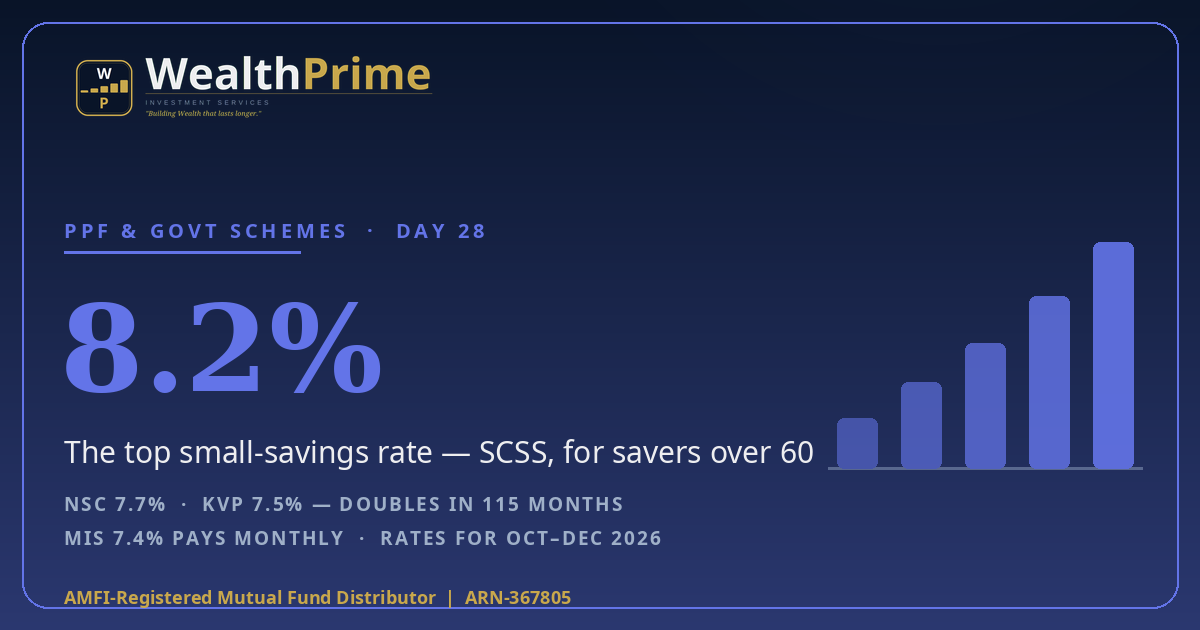
| Senior Citizens Savings Scheme (SCSS) | 8.2% a year | 5 years, extendable by 3 years | Minimum ₹1,000; maximum ₹30 lakh across accounts | Paid every quarter |
| Post Office Monthly Income Scheme (MIS) | 7.4% a year | 5 years | Minimum ₹1,000; maximum ₹9 lakh single, ₹15 lakh joint | Paid every month |
Rates: Government of India quarterly small savings notification for October–December 2026, rates unchanged from the previous quarter. The rate on NSC, KVP, SCSS and MIS deposits is the rate in force when the deposit is made, for that deposit's term; a future quarterly revision changes the rate on new deposits.
NSC and KVP: the two maturity-value certificates
The National Savings Certificate is a five-year certificate that a saver buys once and holds to maturity. The NSC pays 7.7% a year for deposits made in the October to December 2026 quarter, the interest compounds annually, and the saver receives the accumulated amount at the end of five years rather than income along the way. An NSC deposit also qualifies for the Section 80C deduction within the overall ₹1.5 lakh limit under the old tax regime, and the interest that accrues each year is treated as reinvested, so that accrued interest also sits inside the same 80C limit in most years; the interest itself is taxable at the saver's slab rate. Premature closure is restricted to narrow cases such as the holder's death, so a saver should treat the five years as a genuine lock-in.
Kisan Vikas Patra works on a simpler promise: the certificate states no fixed maturity date, and instead the deposited money doubles over the period printed for that issue. At the current 7.5% a year, compounded annually, KVP money doubles in 115 months, which is nine years and seven months. KVP carries no Section 80C deduction on the deposit and no tax benefit on the interest, which is taxable at the slab rate, and a KVP certificate can be transferred between people under the scheme rules. A saver can encash a KVP early only after a lock-in of two and a half years, and the amount paid on an early encashment follows the scheme's table rather than the full doubling promise.
SCSS and MIS: the two regular-income schemes
The Senior Citizens Savings Scheme is restricted to savers aged sixty and above, with a lower entry age of fifty-five for people retiring under superannuation or a voluntary retirement scheme, subject to the scheme's conditions. The SCSS pays 8.2% a year for deposits made this quarter, the highest rate among the four schemes in this guide, and the scheme pays that interest into the saver's account every quarter. The deposit ceiling is ₹30 lakh across all of a saver's SCSS accounts, the term is five years with one extension of three years, and the deposit qualifies for Section 80C within the overall limit under the old regime. The interest is fully taxable at the slab rate, and tax is deducted at source when the interest in a financial year crosses the prescribed threshold.
The Post Office Monthly Income Scheme turns a lump sum into a monthly payment for five years. The MIS pays 7.4% a year for deposits made this quarter, the interest is paid every month, and the original deposit returns at maturity at the end of five years. A single account may hold up to ₹9 lakh and a joint account up to ₹15 lakh, with the joint limit shared between the holders. The MIS offers no Section 80C deduction and its monthly interest is taxable at the slab rate. A saver who closes an MIS account before five years faces a deduction from the deposit — 2% if the closure happens before three years and 1% after three years — so the monthly income comes with a real, if shorter, commitment.
A worked example: the same family, three different jobs
Consider a household placing government-scheme money in November 2026 for three separate jobs, using this quarter's notified rates. First, the household buys a National Savings Certificate of ₹1,00,000 at 7.7% a year, compounded annually. After five years the certificate matures at ₹1,00,000 multiplied by 1.077 five times, which is about ₹1,44,903, so the interest earned is about ₹44,903, taxable at the household's slab rate. Second, a retired parent deposits ₹10,00,000 in the Senior Citizens Savings Scheme at 8.2% a year, which produces interest of ₹82,000 a year, paid as ₹20,500 every quarter, with the ₹10,00,000 deposit itself returning at maturity. Third, the household deposits the maximum ₹9,00,000 in a single Post Office Monthly Income Scheme account at 7.4% a year, which pays ₹66,600 of interest a year, arriving as ₹5,550 every month for five years, again with the deposit returning at maturity.
The three results show why the rate alone never decides the choice: the NSC's 7.7% compounds silently into a maturity value, while the lower MIS rate of 7.4% is the one that pays a monthly income, and the SCSS's 8.2% is available only to a saver who meets its age condition. A household comparing these government payouts with a bank deposit can run its own deposit figures through the FD calculator, and a household that wants to see the market-linked side of the same money can compare mutual funds across categories in the explorer.
Match the scheme to the job, not to the headline rate: NSC and KVP compound quietly toward a maturity value, while SCSS and MIS convert a deposit into quarterly or monthly income, and each of the four carries a different lock-in, limit and tax treatment.
Tax and lock-in: the two lines savers skip
The tax treatment is the least uniform part of this family of schemes. Only the NSC and SCSS deposits qualify for the Section 80C deduction, and that deduction matters only under the old tax regime and only within the shared ₹1.5 lakh basket that also holds EPF, PPF and ELSS contributions. KVP and MIS deposits earn no deduction at all. On the interest side, all four schemes pay taxable interest: NSC, KVP, SCSS and MIS interest is added to the saver's income and taxed at the applicable slab rate, with the NSC's annually accrued interest usually sheltered inside the same 80C limit because the scheme treats that interest as reinvested. None of the four schemes offers the exempt-exempt-exempt treatment that the PPF offers, and the rules stated here are the rules as they stand on the publication date; tax rules can change in a future budget, and this section is general education, not personal tax advice.
The lock-ins deserve the same care. An NSC deposit is committed for five years, a KVP certificate for two and a half years before any early encashment, an SCSS deposit for five years with an early-closure deduction that shrinks the longer the account runs, and an MIS deposit for five years with a 1% to 2% deduction on early closure. Money that a household may need next year therefore does not belong in any of the four schemes, however attractive the notified rate looks; that money belongs in the household's emergency arrangements, held where the household can reach it quickly.
Where mutual funds still fit alongside these schemes
Government small savings schemes and mutual funds solve different problems, and a household plan commonly uses both. The four schemes in this guide pay a government-notified rate on money that is locked in for a stated term, which suits a dated goal or a retired parent's income need, where the household values a known payout pattern over growth. A mutual fund carries no notified rate and no government-set return: a fund's value moves with the market, a fund can fall in value over short periods, and a fund suits a longer-horizon goal where the household can accept that movement in exchange for growth potential. Past performance of any fund is not indicative of future returns, and no figure in this guide should be read as a comparison that promises a fund outcome. The practical division most households use is simple to state: government schemes hold the money that must arrive on a known date in a known form, and mutual funds hold the money whose job is to grow over many years.
Frequently asked questions
What are the current interest rates on NSC, KVP, SCSS and the Post Office MIS?
For deposits made in the October to December 2026 quarter, the National Savings Certificate (NSC) pays 7.7% a year, Kisan Vikas Patra (KVP) pays 7.5% a year, the Senior Citizens Savings Scheme (SCSS) pays 8.2% a year, and the Post Office Monthly Income Scheme (MIS) pays 7.4% a year. The Government of India reviews small savings rates every quarter, so these rates apply to this quarter's deposits and can change for later deposits.
Which small savings schemes give a Section 80C deduction?
Deposits in the National Savings Certificate (NSC) and the Senior Citizens Savings Scheme (SCSS) qualify for the Section 80C deduction within the overall ₹1.5 lakh limit, under the old tax regime. Kisan Vikas Patra (KVP) and Post Office Monthly Income Scheme (MIS) deposits do not qualify for any Section 80C deduction. Interest on all four schemes is taxable at the saver's slab rate, although the NSC's annually accrued interest is treated as reinvested and usually sits inside the same 80C limit.
How long does Kisan Vikas Patra take to double money?
At the current rate of 7.5% a year, compounded annually, a Kisan Vikas Patra (KVP) deposit doubles in 115 months, which is nine years and seven months. A KVP certificate can be encashed early only after a lock-in of two and a half years, and an early encashment pays the amount in the scheme's table rather than the full doubled value.
Who can open a Senior Citizens Savings Scheme account, and what is the limit?
A saver aged sixty or above can open a Senior Citizens Savings Scheme (SCSS) account, and a person retiring under superannuation or a voluntary retirement scheme can open one from age fifty-five, subject to the scheme's conditions. The maximum deposit is ₹30 lakh across all of a saver's SCSS accounts, the term is five years with one three-year extension, and the scheme pays its interest every quarter.
The bottom line
NSC, KVP, SCSS and the Post Office MIS are four government-notified answers to four different needs: a five-year compounding certificate, a certificate that doubles in 115 months, a quarterly income for a saver above sixty, and a monthly income from a five-year deposit. Reading the rate together with the lock-in, the deposit limit and the tax line turns a post-office wall chart into a decision a household can actually make.
Sources: Government of India, Ministry of Finance quarterly small savings notification for October–December 2026 (rates unchanged from the previous quarter), for NSC at 7.7% a year, KVP at 7.5% a year with maturity in 115 months, SCSS at 8.2% a year and the Post Office Monthly Income Scheme at 7.4% a year; the Government Savings Promotion General Rules and the individual scheme rules administered through India Post, for deposit limits (NSC and KVP minimum ₹1,000 with no maximum; SCSS maximum ₹30 lakh; MIS maximum ₹9 lakh single and ₹15 lakh joint), terms, premature-closure deductions and interest payment frequency; the Income-tax Act provisions on Section 80C and slab-rate taxation of scheme interest, as they stand on the publication date. The maturity and income figures are the author's calculations: ₹1,00,000 in NSC at 7.7% compounded annually for five years is about ₹1,44,903; ₹10,00,000 in SCSS at 8.2% pays ₹82,000 a year; ₹9,00,000 in MIS at 7.4% pays ₹5,550 a month. Rates are reviewed quarterly and future rates are not assured.
Government Schemes, Mutual Funds — or Both?
Small savings schemes pay a notified rate on locked-in money; mutual funds carry the long-term growth job. Talk to us on a free, no-pressure call about how the two fit together in your plan.
Prefer chat? WhatsApp us