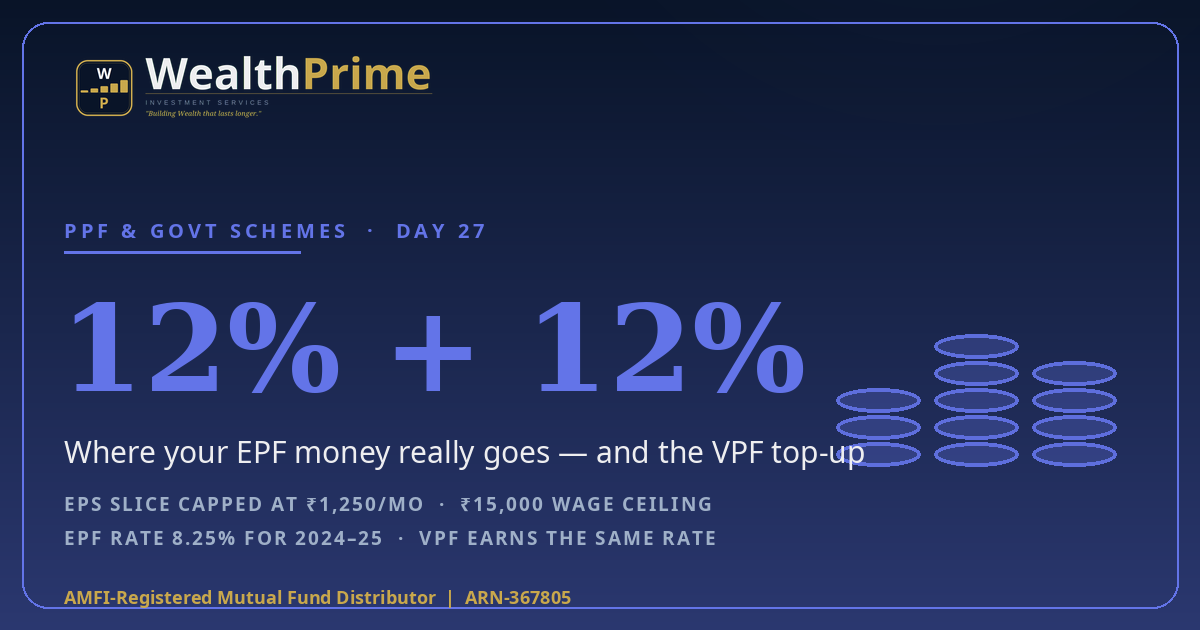
Every month, a salaried employee's payslip quietly moves money into retirement before the employee can spend it. The Employees' Provident Fund, or EPF, takes 12% of basic pay plus dearness allowance from the employee and a matching 12% from the employer, yet very few employees can say where each rupee of that 24% actually goes. Part of the employer's share never reaches the provident fund at all — it funds a separate pension — and the part that does arrive earns an interest rate declared every year by the government.
This guide splits the 12% plus 12% into its three real destinations, explains the Voluntary Provident Fund (VPF) top-up that lets an employee contribute far more than 12%, sets out how EPF interest is taxed above a threshold, and shows how to check a balance and keep the Universal Account Number (UAN) in order across job changes.
The 12% plus 12%: three destinations, not one pot
The employee's contribution is straightforward: 12% of basic pay plus dearness allowance goes entirely into the employee's EPF account, held with the Employees' Provident Fund Organisation (EPFO). The employer's matching 12% is where the split happens. Of the employer's contribution, 8.33% of pay goes to the Employees' Pension Scheme (EPS), but the EPS share is calculated on a wage ceiling of ₹15,000 a month, so the pension contribution is capped at ₹1,250 a month for most salaried employees. The employer's remaining amount — the balance of the 12% after the EPS slice — goes into the employee's EPF account alongside the employee's own contribution.
That split matters for expectations. The EPS slice builds a monthly pension after retirement under the pension scheme's own rules; it does not sit in the EPF balance, does not appear as withdrawable provident fund money, and is not topped up by anything the employee does voluntarily. The EPF account itself — the balance an employee sees in the passbook — is built from the employee's full 12% plus only the employer's non-pension remainder. A reader comparing retirement accounts can also read our guide to the NPS and its Tier 1 and Tier 2 accounts, which use a completely different, market-linked structure.
A worked example: basic pay plus DA of ₹50,000 a month
Consider an employee whose basic pay plus dearness allowance is ₹50,000 a month. The employee contributes 12% of ₹50,000, which is ₹6,000 a month, entirely to the EPF account. The employer also contributes ₹6,000, split two ways: the EPS pension slice is 8.33% of the ₹15,000 wage ceiling, which is ₹1,250 a month, and the remaining ₹4,750 goes into the EPF account. The EPF account therefore receives ₹6,000 plus ₹4,750, which is ₹10,750 a month, or ₹1,29,000 a year, before interest.
EPF interest is declared each year; the rate for 2024–25 was 8.25% a year, credited on monthly running balances. If that employee's ₹10,750 a month continued for twenty years and earned a constant 8.25% a year, compounded monthly, the EPF balance would reach about ₹65,32,000 on contributions of ₹25,80,000 — an illustration, not a forecast or a guarantee, because the declared rate changes from year to year and a real career includes salary rises, job gaps and withdrawals. The same employee can test different salaries and time periods with the PPF calculator for the closest government-scheme comparison, and can compare mutual funds across categories in the explorer for the market-linked side of retirement saving.
Only part of the employer's 12% reaches your EPF balance — ₹1,250 a month is diverted to the pension scheme at the ₹15,000 wage ceiling — and a VPF top-up is the simplest way a salaried employee can raise the EPF side voluntarily, at the same declared interest rate.
VPF: topping up at the EPF rate, without a matching employer share
The Voluntary Provident Fund is not a separate account or a separate scheme. VPF is simply the employee choosing to contribute more than the mandatory 12% of basic pay plus dearness allowance into the same EPF account, through payroll. An employee can raise the contribution substantially — up to 100% of basic pay plus dearness allowance in total under EPFO practice — and the voluntary portion earns exactly the same declared EPF interest rate as the mandatory portion. The employer is not required to match the voluntary portion, and the employer's contribution stays at its normal split no matter how large the employee's VPF becomes.
Using the worked example, suppose the same employee adds a VPF top-up of ₹10,000 a month. Over twenty years the top-up contributes ₹24,00,000, and at an assumed constant 8.25% a year, compounded monthly, it grows to about ₹60,77,000 — again an illustration, not a forecast, because the declared rate is reset every year. Added to the EPF-only illustration above, the combined balance reaches about ₹1,26,09,000. Two cautions belong beside those numbers. First, VPF money follows EPF withdrawal rules, so a top-up is retirement money with limited early access, not a liquid savings pocket; an emergency fund should exist separately. Second, a higher salary changes the tax picture described next, and employees whose own contributions are very large should check the interest-tax threshold before raising VPF sharply.
How EPF interest and withdrawals are taxed
For many years EPF was described as EEE — contributions earned a deduction, interest was exempt, and withdrawals were exempt. That description now needs one qualification. Since financial year 2021–22, the interest that relates to the employee's own contributions above ₹2.5 lakh in a financial year is taxable; where the employer also contributes, the threshold applied is ₹5 lakh. The EPFO calculates the taxable and exempt portions of interest separately, and tax is deducted where applicable. An employee contributing 12% of basic pay plus dearness allowance crosses the ₹2.5 lakh mark only at a fairly high salary, but a large VPF top-up can carry an employee across it sooner, which is why the threshold belongs in any VPF decision.
Withdrawals follow the service rule most employees know: an EPF withdrawal is generally tax-free after five years of continuous service, counting service carried across employers when the account is transferred rather than closed. A withdrawal before five years can be taxed, and tax is deducted at source on larger early withdrawals. Partial withdrawals — called advances — are permitted for specified purposes such as a home purchase, medical treatment, or a child's marriage or education, each with its own service and amount conditions. These rules are stated as they stand on the publication date and can change with future budgets; nothing here is personal tax advice.
UAN, passbook and balance: the three checks every employee should run
The Universal Account Number, or UAN, is the single number that links an employee's EPF accounts across employers. When a salaried person changes jobs, the new employer opens a new member ID under the same UAN, and the old balance should be transferred into the new account rather than withdrawn, so that the five-year service clock and the interest history stay intact. Keeping the UAN activated, with a current mobile number and completed KYC — Aadhaar, PAN and bank details — is what makes transfers, advances and claims work smoothly.
Checking the balance takes minutes once the UAN is active. The EPF passbook is available on the EPFO's member portal and passbook site, and the UMANG app shows the same passbook on a phone. A missed-call and SMS service also returns the latest balance for UANs registered with a mobile number. A yearly passbook check catches the two most common problems early: a month where the employer deposited late or not at all, and an old account that was never transferred after a job change. Both are far easier to fix in the year they happen than at retirement.
Frequently asked questions
How is the employer's 12% EPF contribution split?
The employer's 12% of basic pay plus dearness allowance is split between two schemes. An amount equal to 8.33% of pay, calculated on the wage ceiling of ₹15,000 a month and therefore capped at ₹1,250 a month, goes to the Employees' Pension Scheme (EPS). The rest of the employer's 12% goes into the employee's EPF account, together with the employee's own full 12% contribution.
What is VPF and how much extra can an employee contribute?
The Voluntary Provident Fund (VPF) is an employee's voluntary contribution above the mandatory 12% of basic pay plus dearness allowance, paid through payroll into the same EPF account. An employee can raise the total contribution up to 100% of basic pay plus dearness allowance under EPFO practice. The voluntary portion earns the same declared EPF interest rate, and the employer is not required to match it.
Is EPF interest fully tax-free?
Not entirely. Since financial year 2021–22, the interest relating to the employee's own contributions above ₹2.5 lakh in a financial year is taxable; the threshold is ₹5 lakh where the employer also contributes. Interest up to the threshold remains exempt. EPF withdrawals are generally tax-free after five years of continuous service, counting transferred service across employers. Tax rules are stated as they stand on the publication date and can change.
How can an employee check the EPF balance and UAN status?
With an activated Universal Account Number (UAN), the EPF passbook can be viewed on the EPFO member portal and passbook site or through the UMANG app, and a missed-call or SMS service returns the latest balance to the registered mobile number. Keeping Aadhaar, PAN and bank KYC updated against the UAN keeps transfers, advances and claims working across job changes.
The bottom line
The EPF is already the largest retirement engine most salaried Indians own: the employee's 12% and the employer's non-pension remainder compound at a government-declared rate — 8.25% for 2024–25 — for an entire career. Knowing the EPS split, the ₹2.5 lakh interest-tax threshold and the VPF option turns that engine from a payslip deduction an employee ignores into a retirement building block the employee can actually steer.
Sources: Employees' Provident Funds and Miscellaneous Provisions Act, 1952 and the EPF and EPS scheme provisions administered by the EPFO, for the 12% contribution rates, the 8.33% EPS share and the ₹15,000 wage ceiling; the EPF interest rate of 8.25% a year declared for 2024–25; the Finance Act, 2021 change taxing interest on an employee's own contributions above ₹2.5 lakh a year (₹5 lakh where the employer also contributes). All balances are the author's calculations at a constant illustrative 8.25% a year — ₹10,750 a month for 20 years reaching about ₹65,32,000, a ₹10,000 VPF top-up reaching about ₹60,77,000, and the two together about ₹1,26,09,000. The rate is declared annually and future rates are not assured.
Is Your EPF Working as Part of a Plan?
EPF, VPF, NPS, PPF and mutual funds each solve a different part of retirement. Talk to us on a free, no-pressure call about how your salary's built-in engine fits your wider plan.
Prefer chat? WhatsApp us