Ask ten people how much money they need to retire, and nine will give you a round number they heard somewhere — ₹1 crore, ₹2 crore, ₹5 crore. The number sounds solid. It is also, for most salaried households, wrong — not because it is too big, but because it was never calculated from anything. A retirement corpus is not a guess. It is the answer to a small piece of arithmetic that starts with the one number you already know: what your household spends in a month today.
This article works that arithmetic out step by step, for a real household: a 35-year-old whose family spends ₹60,000 a month today and plans to retire at 60. By the end you will know the monthly expense at 60, the corpus that expense demands, and the monthly SIP that builds it — plus what changes if you start at 25 or 45 instead, and why the famous ₹1 crore target falls short for most families.
Start from your expenses, not a round number
Every round-number retirement target fails the same test: it was chosen first and justified later. ₹1 crore means one thing to a household spending ₹30,000 a month and something entirely different to a household spending ₹1 lakh. A corpus exists for exactly one job — to fund your expenses after the salary stops — so the calculation has to start from those expenses, not from a number that sounds impressive at a dinner party.
Take your household's real monthly spending: rent or home-loan EMI, groceries, school fees, transport, utilities, insurance premiums, and the small regular spending that adds up quietly. Leave out expenses that will genuinely end before retirement — a home loan that finishes in five years, for instance — and do not leave out the ones that will not. For our worked example, the household spends ₹60,000 a month today. If your number is different, the same three steps still work; only the final figure changes.
Step 1 — inflate today's expenses to your retirement year
The ₹60,000 your household spends today will not be ₹60,000 in 25 years. Prices rise every year, and the rise compounds. At an assumed inflation rate of 6% a year — close to India's long-run consumer-price inflation trend — ₹60,000 a month becomes ₹60,000 x 1.0625, which is ₹2,57,512 a month by the time our 35-year-old turns 60. That is the first shock of retirement maths, and it is also the most important: the monthly expense more than quadruples, because 6% a year for 25 years multiplies prices by 4.29 times.
The inflation assumption matters more than most people expect. At 5% a year, the same ₹60,000 becomes ₹2,03,181 a month at 60; at 7%, it becomes ₹3,25,646. The table below shows what different spending levels today turn into at 60, at 6% inflation:
| Monthly expenses today | Monthly expenses at 60 (6% inflation, 25 years) | Annual expenses at 60 |
|---|---|---|
| ₹40,000 | ₹1,71,675 | ₹20.60 lakh |
| ₹60,000 | ₹2,57,512 | ₹30.90 lakh |
| ₹1,00,000 | ₹4,29,187 | ₹51.50 lakh |
One warning before moving on: this step assumes your spending stays the same in real terms. In practice, some costs fall after retirement — no commute, no work wardrobe — while others rise, especially healthcare. Treat the inflated figure as a planning anchor, not a prophecy, and revisit it every few years as your life changes.
Step 2 — turn the expense into a corpus: the 25-times rule
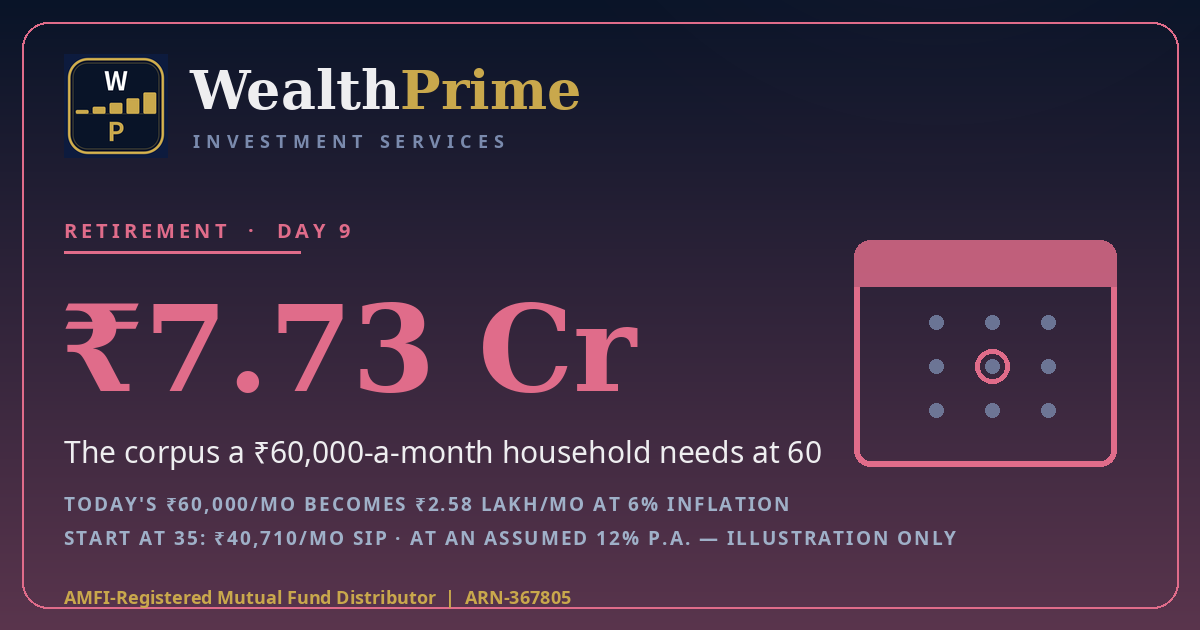
Once you know the annual expense at retirement, the corpus follows from a simple rule: multiply the annual expense by 25. For our household, ₹30.90 lakh a year x 25 = ₹7.73 crore. The rule comes from the idea of withdrawing 4% of the corpus in the first year of retirement and then adjusting that withdrawal for inflation each year — 4% of ₹7.73 crore is ₹30.90 lakh, exactly the first year's expense. The same shortcut in monthly terms is even easier to remember: your corpus is roughly 300 times your monthly expense at retirement (₹2,57,512 x 300 = ₹7.73 crore).
Now the ₹1 crore question answers itself. First, ₹1 crore saved today is worth only about ₹23.3 lakh in today's money after 25 years of 6% inflation — divide ₹1 crore by the same 4.29 factor. Second, at retirement, ₹1 crore covers just 39 months of ₹2,57,512 monthly expenses (₹1,00,00,000 ÷ ₹2,57,512 = 38.8 months), and that is before allowing for the corpus to keep growing or for expenses to keep rising. ₹1 crore is a genuine milestone and worth celebrating. For a household spending ₹60,000 a month today, it is rarely a finish line.
The 25-times rule is a starting point, not a guarantee. It assumes the corpus keeps earning roughly the inflation rate after retirement, that you withdraw about 4% a year, and that the money lasts around thirty years. If you retire early, live longer than expected, or face large medical costs, the number rises. If you retire later or spend less, it falls. The value of the rule is that it turns a vague worry into a concrete target you can plan around — and that is exactly what Step 3 does.
Step 3 — turn the corpus into a monthly SIP
A ₹7.73 crore target sounds impossible until it is broken into a monthly SIP. At an assumed return of 12% a year — an illustration, not a forecast or a guarantee — our 35-year-old needs a SIP of ₹40,710 a month for 25 years to reach ₹7.73 crore. The total amount invested over those 25 years is ₹40,710 x 300 months = ₹1.22 crore; the remaining ₹6.51 crore is the growth on those instalments, which is why starting early matters so much. The same corpus, the same assumed return — only the starting age changes:
Read the chart slowly, because it is the whole argument for starting now. The 25-year-old needs ₹11,894 a month. The 35-year-old needs ₹40,710 — three and a half times as much for the same corpus. The 45-year-old needs ₹1,53,106 a month, more than most salaries can spare. Nobody chooses to start late; most people simply never run the numbers. Running them is the cheapest financial decision you will make all year, and our retirement calculator lets you run your own numbers — your expenses, your age, your retirement year — in under a minute.
Three levers that change the number
If the SIP in Step 3 looks too big, you have three honest levers, and only three. Start earlier — the chart above shows why this is the most powerful lever of all: ten extra years cuts the monthly SIP to less than a third. Spend a little less, or retire a little later — a household spending ₹40,000 a month today needs a ₹5.15 crore corpus instead of ₹7.73 crore, and the SIP from age 35 falls to about ₹27,140 a month; working two extra years has a similar effect, because it adds two years of investing and removes two years of withdrawals. Step the SIP up with your salary — a flat SIP is the hardest way to reach a big corpus, while raising the SIP by 10% every year with your pay hike closes the gap far faster, as our guide to step-up SIPs works out in detail.
What does not work as a lever is hoping for higher returns. A 15% assumption instead of 12% would shrink the SIP on paper, but it is not a plan — it is a wish, and wishes do not pay the bills at 60. Build the plan on the 12% illustration, treat anything better as a bonus, and review the number every two or three years as your salary, expenses, and family change. Before the retirement SIP, keep the foundations in order: an emergency fund of three to six months of expenses, and life cover for the years your family depends on your income. And when the investing itself starts, you can compare diversified equity funds in the fund explorer — facts only, no recommendations — to see how different categories are structured before choosing where your SIP goes.
Your retirement number is not ₹1 crore or ₹5 crore. It is 300 times your monthly expenses at retirement — and for a household spending ₹60,000 today, that is about ₹7.73 crore. The cheapest time to start building it was ten years ago; the second cheapest is this month.
Frequently asked questions
How much corpus do I need to retire in India?
Multiply your annual expenses at retirement by 25. For a household spending ₹60,000 a month today, expenses reach about ₹2,57,512 a month by age 60 at 6% inflation, or ₹30.90 lakh a year — so the corpus is about ₹7.73 crore. Your own number depends on your expenses, your retirement age, and the inflation you assume; run your figures on a retirement calculator and revisit them every few years.
Is ₹1 crore enough to retire in India?
For most salaried households, no. ₹1 crore saved today is worth only about ₹23.3 lakh in today's money after 25 years at 6% inflation, and at retirement it covers roughly 39 months of expenses for a household spending ₹60,000 a month today. It is a real milestone, but it is rarely a complete retirement corpus — unless your expenses are very low or you have other income, such as a pension or rental income.
What is the 25 times rule for retirement?
The 25 times rule says your retirement corpus should be 25 times your annual expenses at retirement, which is the same as withdrawing about 4% of the corpus in the first year. It assumes the corpus keeps earning roughly the inflation rate after retirement and the money lasts around thirty years. It is a planning starting point, not a guarantee — retiring early, living longer, or facing large medical costs all push the number higher.
How much SIP do I need for a comfortable retirement?
It depends on the corpus and the years left. For a ₹7.73 crore target at an assumed 12% a year — an illustration, not a forecast — the monthly SIP is about ₹11,894 starting at 25, ₹40,710 starting at 35, and ₹1,53,106 starting at 45. The most powerful way to shrink the SIP is to start earlier, or to step it up with your salary every year.
The bottom line
Retirement planning is three steps, not a mystery: inflate today's monthly expenses to your retirement year (₹60,000 becomes ₹2,57,512 at 6% inflation over 25 years), multiply the annual expense by 25 (₹7.73 crore), and turn the corpus into a monthly SIP (₹40,710 a month from age 35 at an assumed 12% a year, an illustration). Starting at 25 needs only ₹11,894 a month for the same corpus; starting at 45 needs ₹1,53,106. The number is personal, the maths is simple, and the expensive mistake is never doing it. Work out your own figure today — your expenses, your age, your retirement year — and let the SIP start while time is still on your side.
Sources: inflation at 6% a year is the author's planning assumption, close to India's long-run consumer-price inflation trend; the 25-times rule is the standard 4% withdrawal-rate rule of thumb. SIP figures are the author's own calculations at an assumed 12% a year — illustrations only, not forecasts or guarantees, and past performance is not indicative of future returns. Tax rules are as of 8 Nov 2026 and can change.
Know Your Number, Then Start the SIP
A retirement corpus is just your expenses, inflated and multiplied by 25 — and the SIP that builds it is smaller the earlier you start. Talk to us on a free, no-pressure call about turning your number into a plan.
Prefer chat? WhatsApp us