Ask a room of SIP investors which date they invest on, and the room splits into camps: the 1st-of-the-month camp swears the early investor catches the month’s rise, the salary-day camp invests the moment money lands, and a third camp holds that the 25th buys units cheaper because markets dip at month-end. Each camp defends its date as if the date itself earns a return.
The date earns nothing. A SIP date decides only two practical things: which day’s NAV prices your instalment, and whether your bank account holds enough money when the debit arrives. This article prices the first effect honestly — it is real, and it is tiny — and then covers the second effect, which is the one that actually decides whether a SIP survives.
Why the date question never dies
The question persists because the mechanism underneath it is real. A SIP buys units at the NAV of the day the money is applied, so two investors who invest the same ₹10,000 in the same scheme in the same month receive different numbers of units whenever the NAV differs between their two dates. The investor whose date fell on a lower NAV received more units that month, and the investor whose date fell on a higher NAV received fewer units that month.
What does not follow is that one calendar date stays cheaper than another. A month-end dip that helps the 25th investor in one month hurts the same investor in the next month, when the market rises into month-end instead. NAVs move for reasons that have nothing to do with the calendar — earnings, interest-rate decisions, global markets, news on any given day — and no date in the month holds a permanent discount. The date question feels like a return question; over any long period, the evidence of the arithmetic below is that the date behaves like a rounding question.
What actually decides how many units you get
The unit maths contains no calendar at all. The fund house divides your instalment by that day’s NAV, and that division is the whole transaction. Take one month and three possible NAVs for the same scheme: if the NAV is ₹100 on the 1st, your ₹10,000 buys 100.00 units; if the NAV is ₹102 on the 10th, the same ₹10,000 buys 98.04 units; if the NAV is ₹98 on the 25th, the same ₹10,000 buys 102.04 units. In that month, the 25th investor finishes about 4% ahead on that one instalment — not because the 25th is a better date, but because the NAV happened to be lower on that day.
The next month can reverse the order completely, and across 180 instalments the lucky months and the unlucky months largely cancel. That cancellation is the same averaging a SIP performs in any case: a SIP already buys more units in falling months and fewer units in rising months, whichever date it runs on. An investor who wants to understand what a SIP does and does not promise can read our myth-busting guide on whether a SIP guarantees returns — the short answer is that a SIP averages purchase prices and enforces discipline, and the date changes neither of those two functions.
The worked example: the 1st, the 10th and the 25th over 15 years
Strip the market’s randomness away entirely and give the date its best possible case. Assume a fund grows smoothly at 1% every month — an assumed 12% a year, compounded monthly — with no falls, no flat months and no surprises. That assumption is stated here as an illustration only, not as a forecast or a promise of what any fund will earn, and past performance is not indicative of future returns. In this smooth world, investing earlier in the month is always better, because every instalment compounds for a few extra days. The question is only: better by how much?
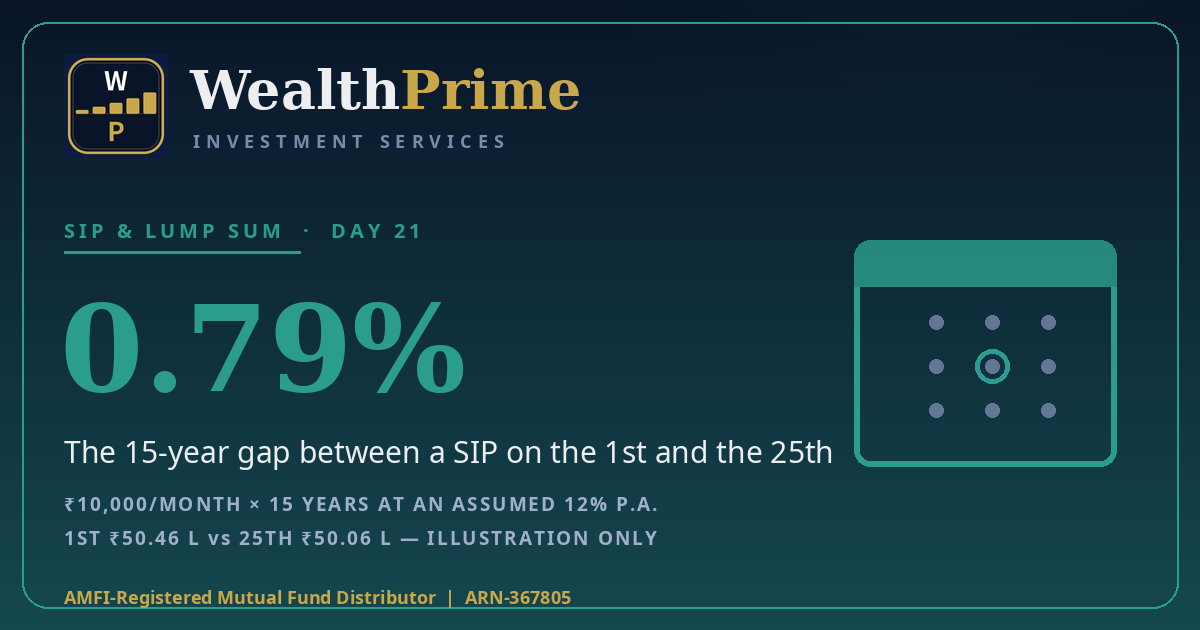
Invest ₹10,000 a month for 15 years — 180 instalments, ₹18,00,000 invested. On the 1st, the plan ends at ₹50,45,760. Move every instalment to the 10th, nine days later, and each instalment compounds for about 0.3 of a month less: the plan ends at ₹50,30,720, which is ₹15,040 less, or 0.30% of the final value. Move every instalment to the 25th, twenty-four days later, and each instalment compounds for about 0.8 of a month less: the plan ends at ₹50,05,754, which is ₹40,006 less, or 0.79% of the final value. Fifteen years of perfect date discipline, in a world built to reward it, buys less than one percent.
Real markets make the gap less reliable still, not more. Because real NAVs jump around instead of gliding, the 25th investor sometimes buys the month’s cheapest NAV and sometimes buys its most expensive one, and the smooth-world advantage of the 1st dissolves into noise that can land on either side. Compare the size of the levers an investor actually controls: in the same illustration, stepping the SIP up by 10% a year, or simply not stopping the SIP through one falling year, moves the final value by lakhs. The date moves it, at most, by about ₹40,000 on ₹50 lakh — and only if the market cooperates with the theory for fifteen straight years. You can test the levers that matter on your own amount in the SIP calculator, where the amount, the years and the step-up are yours to set.
The SIP date changes your final value by less than 1% over 15 years even under assumptions built to favour the earliest date — ₹50.46 lakh on the 1st versus ₹50.06 lakh on the 25th at an illustrative 12% p.a. The amount, the years and not stopping move lakhs; the date moves a rounding difference.
The date that matters is the one just after salary day
The calendar choice that genuinely affects a SIP is not about NAVs at all; the choice is about cash flow. A SIP debit presented when the account is thin fails, and a failed debit has real costs: the fund house allots no units for that month, your bank may levy an auto-debit return charge of typically ₹295 to ₹590, and three failed debits in a row cancel a monthly SIP altogether. Our guide on what happens if you miss a SIP instalment prices each of those consequences in full.
Set against a possible ₹590 charge and a cancelled instruction, a theoretical 0.79% over fifteen years is not a close contest. The practical rule follows directly: place the SIP date one to three days after your salary reliably credits, so the debit meets a funded account in an ordinary month, not only in a good month. An investor whose salary credits on the last working day does well with a date in the first week; an investor paid on the 7th does well in the second week. An investor whose income arrives irregularly — a freelancer, a commission earner — does better with a later date and a buffer of one instalment kept permanently in the debit account, because the buffer, not the date, absorbs a late payment. If a SIP falls on a weekend or a holiday, the debit and the NAV application shift to the next business day under the fund house’s normal processing; that shift is routine and changes nothing about the argument above.
Several SIPs, several dates: does staggering help?
An investor running three or four SIPs sometimes spreads them across the month — one on the 5th, one on the 15th, one on the 25th — hoping the spread diversifies the purchase price. The spread does average entry points within each month, but a single monthly SIP already averages entry points across months, which is where almost all of the averaging benefit lives: 180 monthly purchases smooth the price far more than splitting each month’s purchase into two or three smaller ones. The return effect of staggering dates is, like the date effect itself, too small to measure against market noise.
Staggering dates does have one genuine use, and the use is again cash flow, not returns. Spreading debits across the month can match debits to money arriving at different times — two salaries in a two-income household, or rent received mid-month — and it lowers the balance the account must hold on any single day. An investor who staggers for that reason gets the full benefit; an investor who staggers for extra return gets extra administration. Investors comparing schemes for a new SIP can review funds side by side in the explorer, where each fund’s category and expense ratio are listed together — the scheme and the amount deserve the attention the date usually gets.
So which date should you pick?
Pick the earliest date on which the money is certainly in the account, and then stop thinking about it. In practice that means three checks. First, the date sits after salary credit, with a day or two of margin for a delayed payroll. Second, the date does not collide with the month’s largest fixed outgo on the same morning — a rent debit and a SIP debit competing for the same thin balance is how avoidable failures happen. Third, once the date is set, leave the date alone: changing a SIP date means paperwork or a fresh instruction with most fund houses, and no expected gain repays that friction. The investors who build the largest corpuses are rarely the ones with the cleverest dates; the investors who build the largest corpuses are the ones whose SIPs ran, uninterrupted, for the longest time.
Frequently asked questions
Which date is the best date for a SIP?
There is no date that reliably earns more than another, because no calendar date holds a permanently lower NAV. In an illustration that assumes smooth growth of 1% a month, a ₹10,000 SIP run on the 1st for 15 years ends at ₹50,45,760 and the same SIP run on the 25th ends at ₹50,05,754 — a gap of 0.79%. The practical best date is one to three days after your salary credits, when the debit reliably finds a funded account.
Does changing my SIP date change my returns?
Changing a SIP date changes only which day’s NAV prices each future instalment, and that effect is tiny and can land on either side, because NAVs do not follow the calendar. Changing a date usually needs paperwork or a fresh instruction, and a change made mid-plan also risks a gap month. Investors generally gain more from raising the amount or extending the years than from moving the date.
Can I run SIPs on different dates in the same month?
Yes. Most fund houses let you register SIPs on several dates, and many investors run different schemes on different dates to spread debits across the month. Spreading dates matches debits to when money arrives and lowers the balance needed on any single day, but it does not add a measurable return benefit: one monthly SIP already averages prices across 180 instalments over 15 years.
What happens if my SIP date falls on a weekend or a holiday?
The debit and the unit allotment shift to the next business day under the fund house’s normal processing, and the NAV applied is the NAV of the day the transaction is processed under the scheme’s cut-off rules. The shift is routine, it attracts no charge, and it does not change the instalment amount or the SIP’s registration.
The bottom line
The SIP date is a cash-flow decision wearing a returns costume. The returns effect is real but tiny: at an illustrative 12% p.a. with smooth monthly growth, fifteen years of investing on the 1st instead of the 25th adds ₹40,006 on a ₹50,45,760 outcome — 0.79% — and in real, jumpy markets even that small gap can reverse, because no date owns a cheaper NAV. The cash-flow effect is neither tiny nor reversible: a date set just after salary credit keeps every debit funded, while a date set against a thin account risks a ₹295 to ₹590 bank charge per failed debit and cancellation after three failures in a row. Choose the date your salary makes safe, set the amount your salary can carry, and let the years do the work the date never could.
Sources: All ₹ investment figures are the author’s calculations at the stated assumptions — ₹10,000 a month for 180 months at an assumed 1% a month, with later dates modelled as compounding each instalment for 0.3 months (10th) or 0.8 months (25th) less — an illustration, not a forecast. Bank auto-debit return charges and the three-consecutive-failure cancellation rule are as set out in the author’s guide to missed SIP instalments, from banks’ published schedules of charges and AMFI’s standardised framework in force from 1 April 2024.
SIP Date Worrying You More Than the SIP Itself?
The date moves less than 1% in 15 years; the amount, the step-up and not stopping move lakhs. Talk to us on a free, no-pressure call about setting a SIP your salary can carry every month — date included.
Prefer chat? WhatsApp us