Most Indian savers meet lending from one side only: the saver deposits money in a fixed deposit, and the bank pays interest on that deposit. A bond turns that arrangement around and gives it a name, a tradable certificate and a market price. When an investor buys a bond, the investor is the lender, and a government or a company is the borrower.
This guide explains bonds in plain words for a reader who knows fixed deposits well. It defines the four words printed on every bond — coupon, face value, maturity and yield — shows with real arithmetic why a bond's price falls when interest rates rise, and sets out how a bond differs from a fixed deposit and from a debt mutual fund. The guide explains how the instrument works, so that prices quoted in news and apps stop looking mysterious.
What a bond is: you are the bank
A bond is a loan that the borrower splits into identical, tradable pieces. Instead of borrowing the whole amount from one bank, the borrower — called the issuer — borrows a fixed sum from many investors at once, and each investor receives a bond as evidence of the loan. The issuer pays interest on the loan at a stated schedule, and the issuer repays the original loan amount on a stated final date. An investor who needs money before that final date does not ask the issuer for early repayment; the investor sells the bond to another investor in the market, at whatever price the market offers that day.
That one difference — the loan is tradable — explains almost everything that confuses fixed-deposit holders. A fixed deposit sits at the value printed in the passbook until maturity, apart from credited interest. A bond has two values: the amount the issuer repays at maturity, and the market price at which the bond changes hands today. The market price moves every trading day, even though the interest schedule and the repayment amount stay exactly as printed. A holder who keeps the bond to maturity receives the printed schedule; a holder who sells midway receives the market price, which may be higher or lower than the amount originally paid.
The four words on every bond: coupon, face value, maturity, yield
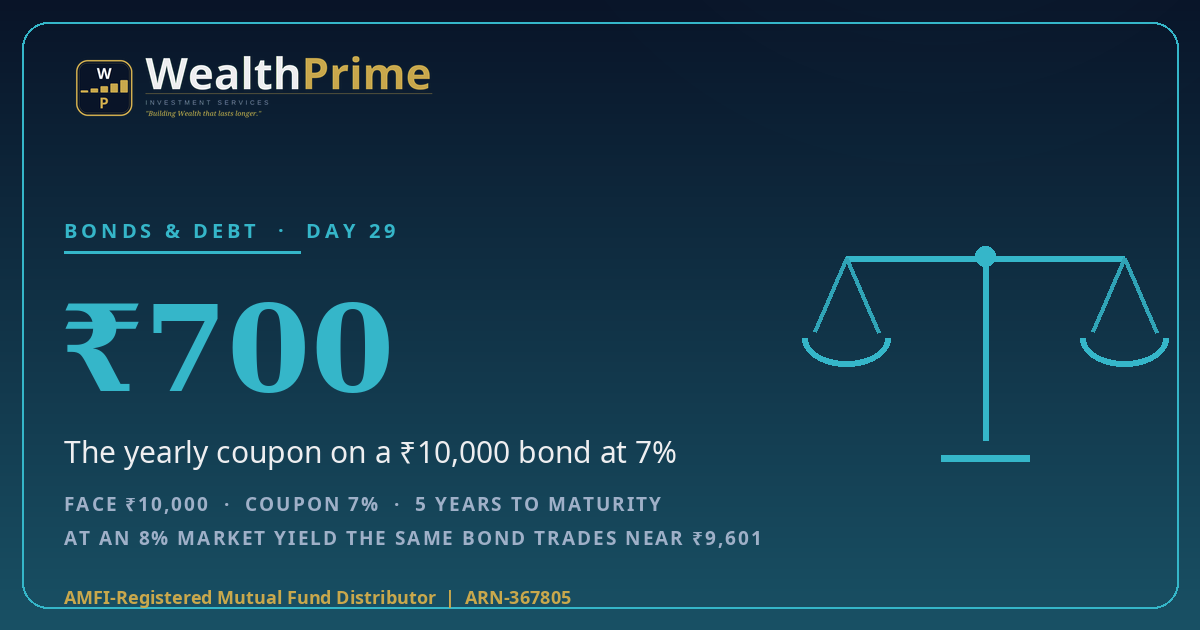
Every bond description uses the same four terms. The face value is the amount the issuer repays at the end and the base on which interest is calculated; ₹10,000 is a common face value for bonds sold to individual investors in India. The coupon is the interest rate printed on the bond, applied to the face value: a bond with a face value of ₹10,000 and a coupon of 7% a year pays ₹700 of interest every year, usually in one or two instalments, for as long as the bond runs. The coupon rate never changes during the bond's life, even when market interest rates move.
The maturity date is the date on which the issuer repays the face value and the bond ends. The time left until that date is the remaining maturity, and it shrinks every day: a ten-year bond bought five years after issue has five years left. Yield causes the most confusion, because the yield is not printed on the bond at all. The yield is the return an investor earns at the price paid today, counting the coupons still to come plus the gap between today's price and the face value repaid at maturity. A bond trading exactly at face value yields exactly its coupon; a bond trading below face value yields more than its coupon, because the buyer also gains that gap at maturity; a bond trading above face value yields less, for the mirror-image reason.
One more term completes the picture: the credit rating. Rating agencies grade issuers on a scale that runs from AAA at the strongest end downward, as an opinion about the issuer's ability to pay interest and repay on time. A lower grade means the market demands a higher yield to lend to that issuer, to compensate for the higher chance of delay or default — so a visibly higher yield is the market pricing a weaker borrower, a longer maturity, or a bond that is harder to sell.
Why bond prices fall when rates rise: the seesaw, with numbers
Interest rates and bond prices move like a seesaw: when market rates rise, prices of bonds already issued fall, and when market rates fall, those prices rise. An existing bond pays a coupon set at issue. If new bonds then offer a higher coupon, no buyer pays full face value for the older bond; its price drops until its yield matches the new bonds. The reverse holds when rates fall: the older bond's higher coupon becomes scarce, so buyers bid its price above face value.
Here is the seesaw in full arithmetic, on one concrete bond. Assume a bond with a face value of ₹10,000, a coupon of 7% a year paid annually, and exactly five years left to maturity, so the holder receives ₹700 a year for five years and then ₹10,000 back. If market yields for similar bonds stand at 7%, this bond trades at ₹10,000, because its coupon already matches the market. If market yields rise to 8%, a buyer who can earn 8% elsewhere discounts every future payment on this bond at 8%: the coupons and the final repayment together are worth about ₹9,601 today, so the market price falls to roughly that level — a loss of about ₹399, or about 4%, for a holder who sells then. If yields instead fall to 6%, the same payments discounted at 6% are worth about ₹10,421, and the price rises by about ₹421. These figures are the author's calculations from the standard present-value formula; they describe this one assumed bond and are not a forecast for any real bond or fund.
Two practical lessons follow. First, the longer the remaining maturity, the harder the seesaw swings, because more years of fixed coupons are being re-priced; a thirty-year bond moves far more for a one-point rate change than a one-year bond does. Factsheets express this sensitivity as duration or modified duration, which is why our guide to debt funds and fixed deposits compared treats the time horizon as the first decision. Second, a price fall becomes a realised loss only if the holder sells. A holder who keeps this bond to maturity still receives ₹700 a year and ₹10,000 at the end, exactly as printed, provided the issuer pays on schedule.
A bond's coupon is fixed at issue, so when market interest rates move, the bond's market price moves the other way until its yield matches the market — and that price movement only becomes a realised gain or loss when the holder sells before maturity.
Government bonds and corporate bonds: who owes you the money
The other great dividing line among bonds is the borrower. Government bonds — dated securities and treasury bills issued by the Government of India, and state development loans issued by state governments — carry the borrowing of the sovereign or a state behind them, and the market treats them as the reference point against which every other borrower's yield is measured. Corporate bonds are issued by companies and non-banking finance companies to raise business funding; each such bond's safety rests on that one issuer's finances, which is why corporate bonds carry credit ratings and why two corporate bonds of the same maturity can trade at noticeably different yields.
The comparison table below places a government bond, a corporate bond and a familiar bank fixed deposit side by side on the features a first-time reader needs. The table states how each instrument works; it does not rank the three, because each one answers a different need and carries a different risk.
| Feature | Government bond | Corporate bond | Bank fixed deposit |
|---|---|---|---|
| Borrower | Government of India or a state government | A company or NBFC | The bank, as a deposit |
| Interest | Fixed coupon on face value, paid on a stated schedule | Fixed coupon on face value, paid on a stated schedule | Rate set by the bank at booking, for the deposit term |
| Price before maturity | Moves daily with market yields; tradable | Moves with market yields and the issuer's standing; tradable | No market price; early closure follows the bank's penalty terms |
| Main risk to understand | Price falls if the holder sells after rates rise | Price movement, plus the issuer's ability to pay (credit risk) | Early-withdrawal penalty and reinvestment at future rates |
| Typical route for an individual | RBI Retail Direct, exchanges, or a gilt or debt fund | Exchanges and regulated online bond platforms, or a debt fund | Directly with the bank |
A saver can run personal deposit figures through the FD calculator to see the maturity value of a stated rate and term.
How Indians actually hold bonds today
Most individual investors in India hold bonds indirectly, through debt mutual funds — which is why bond prices matter even to a person who has never bought a bond directly. A debt fund pools money from many investors and holds a portfolio of bonds, valued at market prices every business day, so the fund's net asset value rises and falls with the seesaw above: gently for funds holding short-maturity bonds, more sharply for funds holding long-maturity bonds. A reader who wants to see which categories hold which kinds of bonds can browse debt funds by category in the fund explorer and read each fund's factsheet for its maturity and rating mix.
Direct routes also exist. The Reserve Bank of India's Retail Direct platform lets an individual open an account and buy government securities in primary auctions and in the secondary market. Listed corporate and government bonds trade on the stock exchanges through a demat account, and SEBI-regulated online bond platforms display listed bonds with their coupons, maturities, ratings and yields. Each direct route asks more of the investor: the investor chooses the issuer, checks the rating and the remaining maturity, and accepts that selling a less-traded bond early may mean taking the price a buyer offers that day.
Frequently asked questions
What is a bond in simple words?
A bond is a tradable loan. The investor lends money to the issuer — a government or a company — the issuer pays interest called the coupon on a stated schedule, and the issuer repays the face value on the maturity date. An investor who needs money earlier sells the bond in the market at that day's price instead of asking the issuer for early repayment.
Why does a bond's price fall when interest rates rise?
A bond's coupon is fixed when the bond is issued. When market rates rise, new bonds pay higher coupons, so buyers pay less for an older bond until its yield matches the market. On the worked example in this guide — a ₹10,000 bond with a 7% coupon and five years left — a rise in market yields from 7% to 8% lowers the price to about ₹9,601, while a fall in yields to 6% raises the price to about ₹10,421.
What is the difference between a bond's coupon and its yield?
The coupon is the interest rate printed on the bond, applied to its face value: a 7% coupon on a ₹10,000 face value pays ₹700 a year, and that rate never changes. The yield is the return a buyer earns at the price actually paid, including the gap between that price and the face value repaid at maturity, so the yield equals the coupon only when the bond trades exactly at face value.
How is a bond different from a fixed deposit?
In a fixed deposit, the saver lends to a bank at a rate the bank sets at booking, and the deposit has no market price; closing it early follows the bank's penalty terms. A bond is a tradable loan to a government or a company with a fixed coupon and a maturity date, and its market price moves daily as interest rates change, so selling a bond before maturity can return more or less than the amount paid.
The bottom line
A bond is a loan with a printed contract and a market price: the coupon states the interest, the face value states the repayment, the maturity states the date, and the yield states what a buyer earns at today's price. Once those four words are clear, the daily movement of bond and debt-fund prices stops being noise and becomes the seesaw doing its ordinary work.
Sources: Reserve Bank of India, RBI Retail Direct scheme description and government securities basics (issuer, coupon, face value, maturity and secondary-market trading of government securities); SEBI investor-education material on bonds and credit ratings, for the rating scale and the role of rating agencies; the standard present-value formula for bond pricing, applied by the author to the assumed bond in the worked example (face value ₹10,000, coupon 7% a year paid annually, five years to maturity: about ₹10,421 at a 6% market yield, ₹10,000 at 7% and about ₹9,601 at 8%). The example bond is an illustration constructed for education; it is not a real security, and its figures are not a forecast or a promise for any bond or fund.
Bonds, Debt Funds and FDs — Which Job Does Each Do?
Bonds, debt funds and fixed deposits each hold safe-side money differently. Talk to us on a free, no-pressure call about how the lending side of your plan fits your goals and time horizon.
Prefer chat? WhatsApp us