Rahul has ₹5 lakh in his savings account, earmarked for a house deposit in three years. His bank offers a fixed deposit at 6.5%; his colleague suggests a debt mutual fund instead, saying it could earn a little more and is “almost like an FD, only better”. For money that must be there in three years, is a debt fund actually better than an FD — or just riskier in a way nobody explains?
This article answers it with numbers: how each option earns its return, what ₹5 lakh becomes in each over three years, how the 2023 tax change removed the debt fund's biggest advantage, and how to match the choice to your horizon. No fund is named; the maths is yours to use.
How an FD earns its return — and why it never surprises you
A fixed deposit is a contract: you hand the bank ₹5 lakh, the bank fixes a rate for a fixed tenure, and on maturity it pays back the principal plus the agreed interest. The rate and the maturity value are locked on day one, and nothing the RBI or the bond market does afterwards changes either number.
As of early November 2026, large banks pay roughly 6.3% to 6.6% a year on 3-year fixed deposits — SBI lists 6.30%, HDFC Bank 6.45% and ICICI Bank 6.55% for the 3-to-5-year bucket. Smaller banks pay a little more, and senior citizens get roughly half a percentage point extra. Rates move slowly: banks revise them after RBI policy moves, and the last one was a 25-basis-point hike that took the repo rate to 5.50% on 7 October 2026, as our repo-rate explainer covers.
Two protections come built in: deposits are insured by the Deposit Insurance and Credit Guarantee Corporation up to ₹5 lakh per depositor per bank, principal plus interest — so Rahul's ₹5 lakh in one bank is fully covered — and the return is immune to market moods. The price of that certainty is a ceiling: if rates rise after you book, your FD stays at the old rate, and breaking it early usually costs 0.5 to 1 percentage point. With consumer inflation forecast at around 5% for FY27, a 6.5% FD also leaves barely a percentage point of real return before tax.
How a debt fund earns its return — interest plus price moves
A debt fund is not a deposit. The fund buys bonds issued by the government and by companies, and your return comes from two sources: the interest those bonds pay, and the change in their prices. The interest part is steady; the price part is not — and it is the whole difference between a debt fund and an FD.
Bond prices and interest rates move on a seesaw: when rates rise, existing bonds paying the old, lower rate become less attractive, so their prices fall; when rates fall, prices rise. A fund's sensitivity is measured by its duration — roughly, a fund with a modified duration of three years loses about 3% if rates rise one percentage point, and gains about 3% if they fall. That is why a debt fund's NAV moves every day, and why it can be worth less than you invested, even briefly. The October 2026 hike showed it: long-duration funds dipped as bond prices adjusted, while overnight and liquid funds were barely touched.
Debt funds come in flavours matched to different horizons, set by SEBI's categorisation: overnight funds hold one-day paper, liquid funds hold paper maturing within 91 days, ultra-short and low-duration funds hold slightly longer paper, short-duration funds hold bonds of one to three years, and gilt funds hold only government bonds. A liquid fund barely notices a rate hike; a long-duration gilt fund feels it in full. The category, not the fund's name, decides how much your money can wobble, and you can compare debt fund categories in the fund explorer to see how each is structured.
The worked example: ₹5 lakh for 3 years
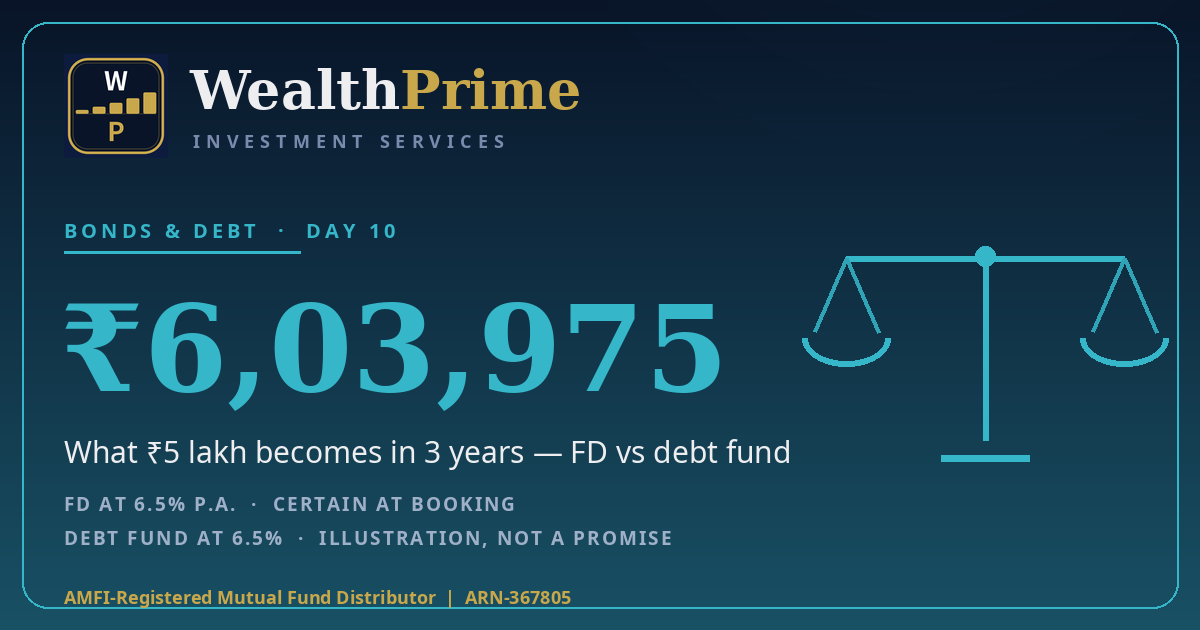
Take Rahul's ₹5 lakh and a three-year horizon. An FD at 6.5% a year, compounded annually, grows to ₹5,00,000 x 1.065³ = ₹6,03,975. The interest earned is ₹1,03,975, and both numbers are certain from the day the FD is booked.
Now put the same ₹5 lakh in a debt fund and assume — for illustration only, not as a forecast — that it earns 6.5% a year too. The maturity value is the same ₹6,03,975, and the gain is the same ₹1,03,975. Same return, same tax — so what is the difference? The path. The FD's value climbs in a straight line; the debt fund's wobbles: if rates rise one percentage point in the first year, a fund with a modified duration of about three years could lose roughly 3% — about ₹15,000 on ₹5 lakh — before higher rates pay it back through better accrual. The money usually recovers, but only if you can wait.
And if the rate rise means the fund averages 5.5% a year over the three years instead of 6.5%, the outcome is ₹5,00,000 x 1.055³ = ₹5,87,121 — about ₹16,854 less than the FD. The chart below shows the three outcomes side by side:
Read the chart as a story about certainty, not returns. The FD's bar is a promise; the debt fund's bars are possibilities — the same as the FD if rates behave, lower if they rise. So the question is not “which earns more?” but “can my plan survive the lower bar?” If the house deposit is due on a fixed date and the amount is non-negotiable, the answer is usually no.
Tax: the 2023 change that levelled the field
Until recently, debt funds had a genuine tax advantage over FDs. Before April 2023, a debt fund held for more than three years was taxed at 20% after indexation — the purchase price was adjusted for inflation, so only the gain above inflation was taxed — while an FD's interest has always been taxed in full at your slab rate. For 30% slab investors, indexation was often worth more than a percentage point of return a year.
The Finance Act 2023 removed it. For debt-oriented funds — funds holding 35% or less in equity — bought on or after 1 April 2023, the entire gain is taxed at your slab rate, however long you hold. There is no indexation and no lower long-term rate. Units bought before 1 April 2023 keep the old treatment, but anything bought since is taxed exactly like FD interest.
Run the tax on the worked example. Rahul is in the 30% slab. The FD's interest of ₹1,03,975 is added to his income, so the tax is 30% — ₹31,192 — leaving ₹5,72,782 after tax. The debt fund's gain of ₹1,03,975 is taxed the same way, leaving the same ₹5,72,782. Before 2023, the debt fund would have kept noticeably more; today, at the same return, the post-tax outcome is identical. The one mechanical difference is timing: the bank deducts TDS of 10% on FD interest once your interest from the bank crosses ₹50,000 in a year (₹1 lakh for senior citizens, from 1 April 2025) — but TDS is only an advance collection, and the full interest is still taxable. A debt fund deducts no TDS; the tax is settled when you file.
| Fixed deposit | Debt fund | |
|---|---|---|
| Return | Fixed at booking; known on day one | Varies with rates; NAV moves daily |
| ₹5 lakh after 3 years | ₹6,03,975 at 6.5% — certain | ₹6,03,975 at an illustrative 6.5%; ₹5,87,121 if a rate rise pulls the average to 5.5% |
| Tax on gains (bought after 1 Apr 2023) | Interest taxed at slab rate | Gains taxed at slab rate — no indexation |
| TDS | 10% once bank interest crosses ₹50,000 a year (₹1 lakh for seniors) | None; tax settled when you file |
| Protection | DICGC cover up to ₹5 lakh per depositor per bank | No deposit insurance |
| Liquidity | Premature withdrawal at 0.5–1 percentage point lower rate | Redeem any working day; liquid funds carry a small exit load in the first 7 days |
| Suits | Fixed date, fixed amount | Flexible date, 1–3+ years, tolerance for wobble |
Matching the money to the horizon
Sort the choice by when the money is needed. Money needed within days or weeks — the emergency fund, next month's rent — belongs in a savings account or an overnight or liquid fund, which redeems the next working day with instant redemption of up to ₹50,000 a day; a small exit load applies if you redeem a liquid fund within its first seven days. Money needed in three to twelve months suits a short FD or an ultra-short or low-duration fund. Money with a fixed date one to three years out — a house deposit, a fee payment — suits an FD, because the date cannot move and the amount cannot shrink. Money that can wait three years or more, with a date that can flex by a few months, is where a short-duration debt fund starts to make sense: its rate risk fades as interest compounds, and its flexibility — no lock-in, no premature-withdrawal penalty — is genuinely useful.
Two habits make either choice work better. First, ladder FDs: split the money across tenures — one, two and three years — so some money always matures soon and you are never forced to break a long FD early. Second, keep the emergency fund out of this debate: it protects the SIP, as our emergency fund guide explains. If you want to see what the same ₹5 lakh would do in a monthly SIP, our SIP vs FD comparison works that maths out. Before choosing, run your own numbers on our FD calculator — the maturity value, the tax, and the post-tax return — so the decision is made on your figures, not on a headline rate.
An FD promises the number; a debt fund promises only the process. If the date is fixed and the amount is non-negotiable, take the promise — the tax outcome is the same either way since 2023, so certainty costs nothing extra.
Frequently asked questions
Are debt funds safer than FDs?
No. An FD with a bank is insured up to ₹5 lakh per depositor per bank by the DICGC, and its maturity value is fixed on the day you book it. A debt fund's NAV moves every day with interest rates — it can fall when rates rise — and it carries credit risk if a bond issuer struggles. A debt fund is an investment, not a deposit, and its return is never certain.
Which debt fund category suits a 3-year horizon?
Investors with a 3-year horizon typically look at short-duration funds and check the fund's average maturity and credit quality in its factsheet, since those two numbers decide how much the NAV can move. The right category depends on how much wobble your plan can absorb — a fixed date with a fixed amount usually points to an FD instead. Compare categories factually in the fund explorer rather than choosing by past returns.
Do debt funds beat FDs after tax now?
Not automatically. Since 1 April 2023, gains on debt-oriented funds bought after that date are taxed at your slab rate with no indexation — the same treatment as FD interest. A debt fund only beats an FD after tax if its pre-tax return is higher, and that is never certain. Units bought before 1 April 2023 keep the old indexation benefit.
Can I lose money in a debt fund?
Yes, in the short term. If interest rates rise, a debt fund's NAV falls — roughly 3% for a fund with a 3-year duration after a 1-percentage-point rise — and a credit event can hurt more. Liquid and overnight funds move the least, long-duration and gilt funds the most. The fall is usually temporary if you can hold through it, because the fund then earns the higher rates — but a fixed deadline may not give you that time.
The bottom line
An FD and a debt fund are both places for safe money, but they sell different things: the FD sells certainty, the debt fund sells flexibility. On ₹5 lakh for three years, an FD at 6.5% returns a certain ₹6,03,975 (₹5,72,782 after 30% tax), while a debt fund at the same illustrative rate returns the same only if rates stay put — about ₹5,87,121 if a rate rise pulls its average to 5.5%. Since the 2023 tax change, the post-tax maths is the same at the same return, so the decision is about your deadline: fixed date, fixed amount — take the FD; flexible date, tolerance for wobble — a short-duration debt fund is a reasonable alternative.
Sources: RBI MPC decision, 7 Oct 2026 — repo rate 5.50%; BankBazaar / The Hindu BusinessLine FD rates, 30 Oct 2026 — SBI 6.30%, HDFC 6.45%, ICICI 6.55% (3-to-5-year); Finance Act 2023 — debt funds (35% or less equity) bought on or after 1 Apr 2023 taxed at slab rates, no indexation; Finance Act 2025 — Section 194A TDS thresholds ₹50,000 (₹1 lakh seniors) from 1 Apr 2025; DICGC cover ₹5 lakh per depositor per bank. Debt fund returns here are illustrations, not forecasts; past performance is not indicative of future returns. Tax rules as of 9 Nov 2026 and can change.
Match the Money to the Horizon
An FD suits money with a fixed date and no tolerance for wobble; a debt fund suits money that can ride out rate moves. Talk to us on a free, no-pressure call about where your safe money should sit.
Prefer chat? WhatsApp us