When Arjun, a 31-year-old software engineer in Pune, opened his first mutual fund statement, he counted four different equity funds — and still could not say what size of companies his money actually owned. One fund held mostly large companies, one chased small ones, and two sat somewhere in between. He had bought diversification, but what he really owned was a puzzle.
A flexi-cap fund is built for exactly that confusion. It is a single equity fund whose manager is allowed to invest across large, mid and small companies in any proportion, shifting the mix as conditions change. This article explains what the category means under SEBI's rules, how it differs from multi-cap and large-cap funds, how a manager actually moves money between market caps, and what a long SIP in such a fund could look like in illustrative numbers.
What "flexi-cap" actually means
A flexi-cap fund is an open-ended equity scheme that invests across companies of every market capitalisation — large-cap, mid-cap and small-cap — with no fixed minimum for any single band. SEBI created the category in November 2020 (circular dated 6 November 2020), after its new multi-cap rule required multi-cap funds to hold at least 25% each in large, mid and small caps. Fund houses wanted a category that kept the old freedom to move across caps, and flexi-cap was the answer.
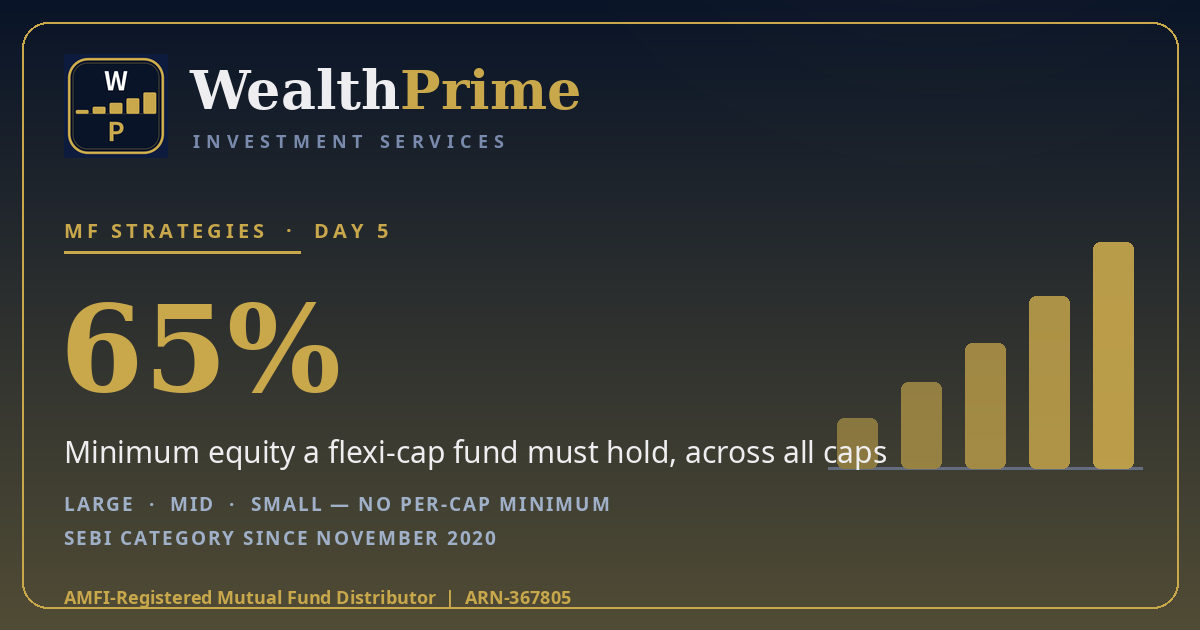
The category carries exactly one hard floor: at least 65% of the fund's total assets must be invested in equity and equity-related instruments. Beyond that floor, the manager decides everything — 70% in large companies and 10% in small ones, or the reverse, or anything in between. The scheme document of each fund states its own approach, so two flexi-cap funds can look quite different from each other while sharing the same category label.
The market-cap bands themselves come from SEBI's definitions, which every equity fund uses. Large-cap companies are the top 100 companies by market capitalisation, mid-cap companies are ranked 101 to 250, and small-cap companies are ranked 251 and below. A flexi-cap manager fishes in all three pools at once, which is why the category is often described as a whole-market fund in a single folio.
Flexi-cap vs multi-cap vs large-cap: the table that settles it
The three categories sound similar and behave differently, because SEBI's rules tie each manager's hands to a different degree. The table below states the rule for each category — these are category definitions, not opinions about which category performs better.
| Category | Minimum equity | Per-cap rule | What the manager can do |
|---|---|---|---|
| Flexi-cap | 65% of assets | None — no minimum in any cap band | Move freely across large, mid and small caps in any proportion |
| Multi-cap | 75% of assets | At least 25% each in large, mid and small caps | Shift the remaining 25% freely, but must always hold all three bands |
| Large-cap | 80% in large-cap stocks | At least 80% in the top 100 companies | Stay anchored in large companies, with limited room elsewhere |
The practical difference shows up in a market rotation. Suppose small companies have run up sharply and look expensive while large companies look reasonable. A large-cap manager cannot react much — the mandate keeps the fund in large companies anyway. A multi-cap manager must keep at least 25% in small companies even while believing they are expensive. A flexi-cap manager can cut small-cap exposure close to zero and wait. That freedom is the entire point of the category — and, as the next section explains, also its main risk.
How the manager actually moves across market caps
Flexibility sounds abstract until you see a portfolio snapshot. The chart below shows an illustrative flexi-cap allocation — not any real fund's portfolio, but the kind of mix a flexi-cap factsheet might show at a moment when the manager favours stability: a large-cap anchor, a meaningful mid-cap allocation, and a smaller small-cap position.
Managers shift this mix for three ordinary reasons. First, valuations: when one band looks expensive relative to its earnings, the manager trims it. Second, the economic cycle: smaller companies often lead a recovery and lag a slowdown, so the mix tilts with the manager's view of growth. Third, risk control: raising the large-cap share steadies the fund when volatility rises, because large companies generally fall less sharply than small ones.
Here is the honest counterweight. Flexibility is only as good as the judgement behind it. A manager who shifts into small companies just before a correction, or out of them just before a rally, has used the freedom badly — and the investor bears the result. Flexi-cap funds therefore need the same factsheet reading as any active fund: check the market-cap allocation over several quarters, not one, and ask whether the shifts look deliberate or reactive. A fund whose allocation swings wildly every quarter is telling you something about its process, and it is worth listening.
The worked example: ₹10,000 a month for 15 years
Take Arjun's situation as the worked example. He invests ₹10,000 a month through a SIP for 15 years — 180 instalments, ₹18,00,000 invested in total. At an assumed return of 12% per annum, compounded monthly, the illustration works out to about ₹50.46 lakh at the end of 15 years, of which about ₹32.46 lakh is growth over the amount invested. The 12% figure is an assumption chosen for illustration only — it is not a forecast, not a promise, and not what any particular fund has delivered or will deliver. Actual returns vary with the market and with the fund's own decisions, and a real outcome could be materially higher or lower.
What the example really shows is time doing the heavy lifting. The same ₹10,000 a month over 10 years at the same assumed 12% would illustrate to roughly ₹23.23 lakh, so the extra five years — from year 10 to year 15 — add more than the first ten years combined. That is compounding: growth earning its own growth. It is also why flexi-cap funds, which are equity funds with full market ups and downs, suit goals that are at least five to seven years away rather than money needed next year. Readers who want to test their own numbers can run them on our SIP calculator, changing the monthly amount, the years and the assumed return to see how sensitive the outcome is to each input.
Reading a flexi-cap factsheet, and who the category suits
Four numbers on the factsheet tell you most of what you need. First, the market-cap allocation — the large/mid/small split discussed above, and how it has moved over the last few quarters. Second, the expense ratio (TER): flexi-cap funds are actively managed, so their TER is higher than an index fund's, and the gap compounds over years, as our guide on index funds vs actively managed funds shows in worked numbers. Third, the portfolio's top holdings and sector mix — a flexi-cap fund concentrated in two sectors is not the diversified fund its label suggests. Fourth, the exit load and the fund's own stated strategy, so there are no surprises on redemption or on style drift.
As a first equity fund, the category has a genuine education-framed case: one fund covers the whole market, so a beginner does not need to decide the large-vs-mid-vs-small split personally, and does not need three funds to get it. But "first fund" does not mean "safe fund" — a flexi-cap fund is still 65% or more in equity, so it can fall 20% or more in a bad year, and it needs a long horizon and a stomach for that volatility. Investors who want to compare flexi-cap funds in the explorer can browse them factually in our fund explorer, checking each fund's allocation and costs side by side rather than relying on the category label alone.
A flexi-cap fund gives its manager one freedom no other diversified equity category allows — any mix of large, mid and small companies, above a 65% equity floor. Judge the fund by how wisely it uses that freedom over several quarters, not by the label on the tin.
Frequently asked questions
What is the difference between a flexi-cap fund and a multi-cap fund?
Both invest across large, mid and small companies, but the rules differ. A flexi-cap fund must hold at least 65% in equity with no minimum in any market-cap band, so the manager can move freely between bands. A multi-cap fund must hold at least 75% in equity with at least 25% each in large, mid and small caps, so it must always hold all three bands. Flexi-cap is freedom; multi-cap is a forced spread.
Can a flexi-cap fund invest 100% in small-cap stocks?
In theory, yes — there is no per-cap floor stopping it, as long as the 65% equity minimum is met. In practice, flexi-cap funds rarely do this, because their scheme documents describe a diversified approach and their investors expect one. Always check the fund's actual market-cap allocation in its factsheet rather than assuming what the label permits.
Is a flexi-cap fund safer than a small-cap fund?
It is generally less volatile than a pure small-cap fund, because spreading money across large, mid and small companies diversifies the risk of any single band falling. But it is not safe in absolute terms: it is still an equity fund, it can fall sharply in a market correction, and its value is not assured. Diversification reduces one kind of risk; it does not remove market risk.
How are flexi-cap funds taxed?
Flexi-cap funds are taxed as equity funds. As of the publish date of this article, long-term capital gains (units held over 12 months) are taxed at 12.5% on gains above ₹1.25 lakh in a financial year, and short-term gains are taxed at 20%. Tax rules can change with future budgets, so check the rules in force at the time of redemption. This is general information, not personal tax advice.
The bottom line
A flexi-cap fund is the equity category with the fewest constraints: at least 65% in equity, no minimum in any market-cap band, and a manager free to tilt toward large companies for stability or small ones for growth. That freedom is valuable when it is used with discipline — a large-cap anchor with selective mid- and small-cap exposure, adjusted gradually — and costly when it is used reactively. Before choosing one, read the factsheet's market-cap history over several quarters, note the expense ratio, and match the fund to a goal at least five to seven years away. The category does the cap-allocation thinking for you; your job is to check that the thinking is sound, and then to give it time — a ₹10,000 monthly SIP over 15 years illustrates to about ₹50.46 lakh at an assumed 12% per annum, but only if the investor stays invested through the falls in between.
Sources: SEBI circular SEBI/HO/IMD/DF3/CIR/P/2020/228 dated 6 November 2020 (flexi-cap category, 65% equity minimum); SEBI's September 2020 multi-cap rule (75% equity, 25% each in large, mid and small caps); SEBI market-cap definitions (large = top 100, mid = 101–250, small = 251+ companies); the worked figures are the author's own calculations from the stated SIP, period and assumed-return assumptions.
One Fund Across Every Market Cap
A flexi-cap fund can be a sensible first equity fund — if its manager uses the freedom well. Talk to us on a free, no-pressure call about whether it fits your goals and horizon.
Prefer chat? WhatsApp us