A ₹1.2 lakh bonus lands in your account on a Friday. By Monday, two voices are arguing in your head. One says invest it all right now, before the market moves on. The other says spread it out — ₹10,000 a month for a year — so a sudden fall does not swallow the whole amount in one go. Both can be right and both can be wrong, because the answer depends on what the market does next, which nobody knows in advance.
This article settles the question the only honest way: with arithmetic. It runs the same ₹1,20,000 through both methods in two different markets, checks what decades of data say, and ends with a decision flow based on where your money comes from — salary, bonus, or windfall. Every worked figure is an illustration built from stated assumptions, not a forecast.
What a SIP actually does — and what it does not
A systematic investment plan is an instruction to invest a fixed amount on a fixed date every month, whatever the market is doing. When the NAV is low, that amount buys more units; when it is high, fewer. This automatic buying of more when prices fall and less when they rise is rupee-cost averaging — the SIP's real mechanism, removing the monthly decision of whether this is a good time to invest.
The SIP's second benefit is that it matches how most people earn: a salary arrives monthly, so a monthly investment is the natural shape for it. The money is invested before it can be spent, and the habit runs without willpower. That discipline, not any magic in the averaging, is what builds most SIP wealth.
What a SIP does not do is protect against losses. If a fund's NAV falls 20% and stays there, a SIP in that fund falls too — the investor simply owns more units of a cheaper fund. A SIP also cannot invest money that does not exist yet — it is the wrong tool for a bonus already sitting in the bank.
What a lump sum does — the timing question
A lump sum invests the whole amount on a single day, so the full amount is exposed from day one. If the market rises, the entire amount benefits; if it falls, the entire amount falls, with no averaging cushion and no later instalments arriving at lower prices to soften the blow. The outcome is decided by one thing: whether the market is higher or lower later than on the day of investment.
That is a question nobody can answer in advance. The honest counterweight is time horizon: over seven years or more, years of compounding wash out the effect of any single month's price, so the entry point matters far less than it feels like on day one. Over one or two years, it matters a great deal — and equity, by either method, is the wrong place for money needed that soon.
A lump sum is the natural starting point whenever the money already exists: a bonus, a maturity payout, sale proceeds, an inheritance. The money is in hand; the only question is how fast to put it to work.
The worked example: the same ₹1,20,000, two ways, two markets
Take Ritu, who receives a ₹1,20,000 annual bonus and uses the same equity fund for both options. Option L: invest the whole ₹1,20,000 at once at NAV ₹100, buying 1,200 units. Option S: invest ₹10,000 a month for 12 months as a SIP. Both run for the same 12 months and end at the same NAV of ₹115 — the only difference is the path the market takes to get there.
Scenario A — the market falls first, then recovers. The NAV drops to ₹80 by month five, then climbs back to ₹115. The SIP buys more units precisely when prices are lowest:
| Month | NAV (₹) | SIP units bought (₹10,000) |
|---|---|---|
| 1 | 100 | 100.00 |
| 2 | 95 | 105.26 |
| 3 | 90 | 111.11 |
| 4 | 85 | 117.65 |
| 5 | 80 | 125.00 |
| 6 | 82 | 121.95 |
| 7 | 88 | 113.64 |
| 8 | 92 | 108.70 |
| 9 | 98 | 102.04 |
| 10 | 105 | 95.24 |
| 11 | 110 | 90.91 |
| 12 | 115 | 86.96 |
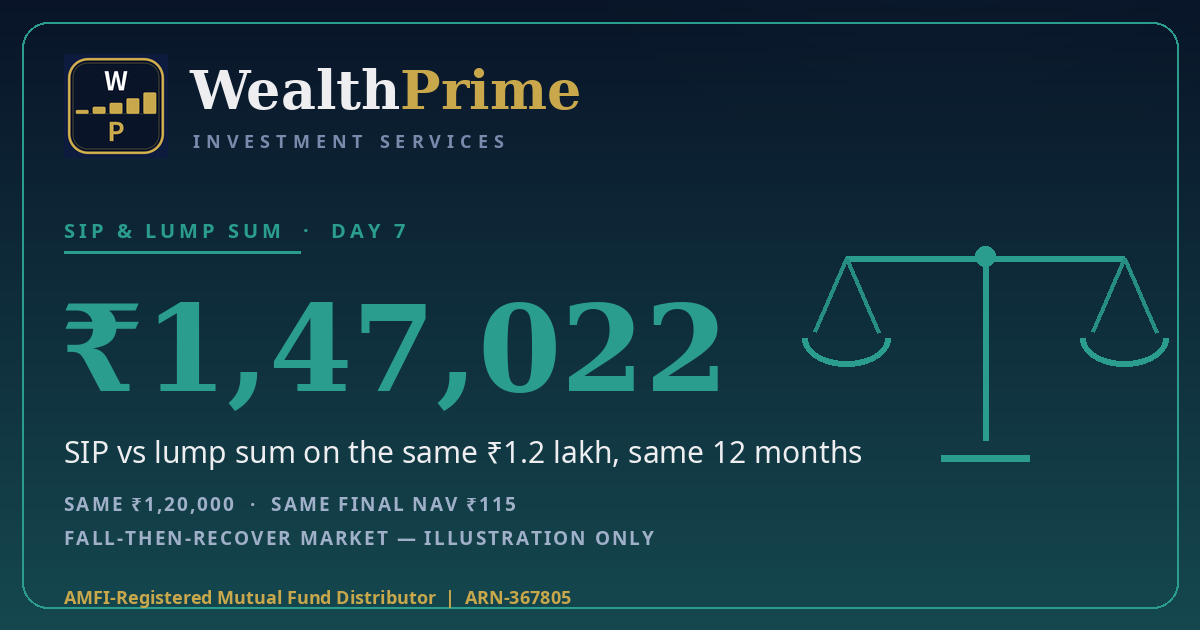
The SIP ends with 1,278.45 units — more than the lump sum's 1,200 — at an average cost of ₹93.86 per unit. At the final NAV of ₹115, the SIP is worth ₹1,47,022, a gain of ₹27,022 (about 22.5%). The lump sum is worth 1,200 x ₹115 = ₹1,38,000, a gain of ₹18,000 (15%). In a market that dips first, the SIP wins by ₹9,022.
Scenario B — the market rises steadily. The NAV climbs from ₹100 to ₹115 without a dip, so every SIP instalment buys at a higher price than the one before. The SIP ends with only 1,118.43 units at an average cost of ₹107.29, worth ₹1,28,619 at the final NAV — a gain of about 7.2% — while the lump sum is again worth ₹1,38,000. In a steadily rising market, the lump sum wins by ₹9,381.
The winner flips with the path the market takes, and the path cannot be known in advance: a SIP wins when the market dips early, a lump sum wins when it rises steadily. Anyone who claims one method always wins is selling certainty that does not exist. Readers can test their own numbers on our SIP calculator and lump sum calculator.
What history says: the lump sum wins about two-thirds of the time
The worked example shows both methods can win. History shows one wins more often. Vanguard's research paper Cost averaging: Invest now or temporarily hold your cash? (first published in 2012 and updated in 2023) compared investing a lump sum immediately against spreading the same money over 12 months, across decades of market history and in global markets from 1976 to 2022. The headline finding: the lump sum outperformed the 12-month averaging schedule in roughly two-thirds of rolling periods — about 68% for global stocks — with an average advantage of roughly 2.3 percentage points for a 60% stock / 40% bond portfolio.
The reason is simple: markets rise more often than they fall, so money invested earlier spends more time invested, while money held back for instalments spends months earning little or nothing. The study's authors put it bluntly in the original title: dollar-cost averaging just means taking risk later.
But the one-third matters too: in the periods when averaging won, it often won by a lot — those are the periods when markets fell hard just after the lump sum went in. The lump sum's advantage is an average, not a promise, and past performance is not indicative of future returns. The data answers the maths question, not the human one: whether an investor who watches a fresh ₹1.2 lakh fall 20% in three months stays invested or panics and sells. For many people, that is the real decision.
The middle path: lump sum plus STP
There is a third option that takes the best of both methods. It is called a systematic transfer plan, or STP. The full amount goes into a liquid or overnight fund — a low-volatility debt fund — and a fixed amount moves automatically into the chosen equity fund every month, say ₹10,000 a month for 12 months. The parked money earns a modest return while it waits, and the equity exposure builds gradually, so a sudden fall hits only the portion already transferred.
An STP is a transfer between two funds of the same fund house, and each monthly transfer is a redemption from the source fund, so the tax rules on the source fund's gains apply. The practical choice is the transfer period: six months if you are fairly comfortable deploying the money, twelve if the thought of a fall keeps you up at night. A longer STP is not free — the Vanguard finding says the longer the wait, the larger the average cost of waiting — but a plan you can stick to beats a theoretically better plan you abandon at the first fall.
A decision flow by where the money comes from
The cleanest way to choose is to start from the money, not from a prediction about the market:
- Salary, arriving monthly: a SIP. The money does not exist yet as a lump sum, so there is nothing to deploy at once. Start it on salary day, and raise it when the salary rises — our guide to step-up SIPs works through the maths.
- Bonus, maturity payout, sale proceeds or inheritance, already in hand: a lump sum if the horizon is seven years or more and you can stomach a 20–30% interim fall without selling; an STP over 6–12 months if that fall would keep you up at night. Either route beats leaving the money in a savings account — even averaging beat sitting in cash in about 69% of the periods Vanguard studied.
- Money needed within three years: neither. An equity SIP and an equity lump sum are both the wrong tool for a near-term goal; that money belongs in a fixed deposit or a liquid fund. Our comparison of SIP vs FD explains where each belongs.
- A windfall while SIPs are already running: either a fresh lump sum into the same goal or a step-up of the existing SIP. What matters is that the money gets a job quickly instead of waiting for a perfect entry point.
One last check before either method: is the emergency fund already built? Money in equity is not emergency money — it can be down exactly when it is needed most. Build the safety net first; the market will still be there afterwards. Readers comparing funds factually can browse categories in our fund explorer, checking each fund's costs and portfolio rather than relying on past returns.
SIP and lump sum are not rivals — they are answers to different questions. A SIP fits money that arrives monthly; a lump sum fits money that already exists. The method that wins is decided by the market's path, which no one can predict — so choose by your income pattern and your stomach for a fall, not by a guess about next month.
Frequently asked questions
Is a SIP better than a lump sum?
Neither is universally better. A lump sum has outperformed a 12-month averaging schedule in roughly two-thirds of historical periods studied by Vanguard, because markets rise more often than they fall. But a SIP wins whenever markets dip early, and it is the only option for money that arrives monthly as salary. The right choice depends on whether the money already exists as a lump sum, the investment horizon, and whether the investor can stay invested through a fall.
What is an STP, and when should I use one?
A systematic transfer plan moves a fixed amount automatically from a liquid or overnight fund into an equity fund each month. Use it when you have a lump sum but want to spread the entry over 6 to 12 months instead of investing all at once. The parked money earns a modest return while it waits, and only the transferred portion is exposed to a market fall. Each transfer is a redemption from the source fund, so its tax rules apply.
Can I do a SIP and a lump sum in the same fund?
Yes. A fund can receive both a monthly SIP and additional lump-sum investments at any time, and many investors do exactly that: a regular SIP from salary, plus lump sums from bonuses or maturity payouts into the same goal. Keep the goal and horizon the same for both, and track the combined investment against that goal rather than judging each method separately.
Should I invest a lump sum when the market is at an all-time high?
An all-time high is normal for a growing market, not a warning signal on its own — markets spend much of their time near highs. What matters is the horizon: for money needed in seven or more years, history favours investing rather than waiting, with roughly two-thirds of periods rewarding immediate investment. If the high makes you nervous, an STP over 6 to 12 months is a reasonable middle path. This is general education, not personal advice.
The bottom line
The same ₹1,20,000 ends at ₹1,47,022 by SIP if the market dips first, and at ₹1,28,619 if it rises steadily — while a lump sum ends at ₹1,38,000 in both cases. The SIP wins on a falling path, the lump sum on a rising one, and history says rising paths come up about twice as often. The practical answer follows the money: salary that arrives monthly belongs in a SIP; a bonus or windfall already in hand belongs in a lump sum, or in an STP over 6 to 12 months if a sudden fall would shake you out. The expensive mistake is the same either way: leaving the money in a savings account while waiting for a perfect entry point.
Sources: Vanguard, Cost averaging: Invest now or temporarily hold your cash? (2012, updated 2023) — lump sum beat 12-month averaging in roughly two-thirds of rolling periods, about 68% for global stocks 1976–2022, average advantage about 2.3 percentage points for a 60/40 portfolio; the worked SIP and lump-sum figures are the author's own calculations from the NAV paths stated in the text. Past performance is not indicative of future returns, and all projections here are illustrations, not forecasts or guarantees.
Salary, Bonus, or Windfall — Start the Right Way
A SIP fits money that arrives monthly; a lump sum or an STP fits money that arrives all at once. Talk to us on a free, no-pressure call about deploying your money the way that suits your income and your goals.
Prefer chat? WhatsApp us