Every January, the same scene plays out in offices across India: a colleague discovers that a chunk of salary has gone to tax that could have been reduced, and rushes to buy whatever tax-saving product a friend mentions first. The product usually bought in that hurry is an ELSS fund — and the hurry is the problem, because ELSS is the only mutual fund that saves tax, and it comes with a three-year lock-in that cannot be undone.
This article explains ELSS in plain terms: what it is, how the ₹1.5 lakh Section 80C limit works, when the deduction matters at all under the old versus new tax regime, what happens to tax at exit, and how ELSS compares with PPF for the tax-saving slice of a portfolio. All tax figures are stated as of the publish date of this article, and tax rules can change with future budgets.
What an ELSS fund actually is
ELSS stands for Equity Linked Savings Scheme. It is an open-ended equity mutual fund that qualifies for a tax deduction under Section 80C of the Income-tax Act, and it is the only mutual fund category that does so. Under SEBI's rules, an ELSS fund must invest at least 80% of its assets in equity and equity-related instruments, so it behaves like any other diversified equity fund: its value rises and falls with the stock market, and nothing about its return is assured.
What makes ELSS different from an ordinary equity fund is the lock-in. Every rupee invested in an ELSS fund is locked in for three years from the date of that investment, and it cannot be redeemed early — not for an emergency, not for a better opportunity, and not because the market fell. For a lump-sum investment, the three years run from the investment date. For a SIP, each monthly instalment carries its own three-year lock-in from its own date, so the first instalment frees up after three years while the last instalment of a three-year SIP frees up after six years in total. That rolling lock-in is the single most misunderstood feature of ELSS, and it is the reason ELSS money should never be money that might be needed soon.
Three years is also the shortest lock-in among Section 80C options — PPF locks money for 15 years, a five-year tax-saving fixed deposit for five years, and the National Savings Certificate for five years — which is part of why ELSS is popular. But "shortest lock-in" is not the same as "liquid": for three years, the money is simply not available.
The ₹1.5 lakh Section 80C basket
Section 80C allows a deduction of up to ₹1.5 lakh per financial year from taxable income, but the limit is shared across a whole basket of investments and expenses — it is not ₹1.5 lakh per product. The basket includes ELSS, Public Provident Fund (PPF) contributions, Employees' Provident Fund (EPF) contributions, life insurance premiums, National Savings Certificates, five-year tax-saving fixed deposits, Sukanya Samriddhi Yojana deposits, tuition fees for children, and principal repayment on a home loan, among others.
The practical consequence is that many salaried investors already fill much of the basket without trying. An employee whose EPF contribution is ₹80,000 a year and who pays ₹40,000 in life insurance premiums has already used ₹1,20,000 of the ₹1.5 lakh limit, leaving only ₹30,000 of room for ELSS or anything else in the basket. Buying ₹1.5 lakh of ELSS on top of that does not create an extra ₹1.5 lakh deduction — only ₹30,000 of it would actually reduce taxable income. Before buying ELSS for tax saving, the sensible first step is to add up what the basket already contains from EPF, insurance, PPF and other items, and invest only up to the remaining room.
It is also worth stating plainly what a deduction is. A ₹1.5 lakh deduction does not save ₹1.5 lakh of tax. It reduces taxable income by ₹1.5 lakh, and the tax saved equals that amount multiplied by the investor's marginal tax rate, including the 4% health and education cess. The chart below shows what that means at three common slabs.
Old regime vs new regime: when 80C even matters
Here is the catch that makes ELSS irrelevant for many investors today. The Section 80C deduction exists only under the old tax regime. Under the new tax regime — which has been the default regime since financial year 2023-24 — Section 80C deductions are not available at all, and most other deductions are gone too, in exchange for lower slab rates and a higher standard deduction.
So the decision order is backwards from how most people approach it. The first question is not "which ELSS fund should I buy" but "which regime leaves me with less tax overall". An investor compares total tax under both regimes, counting every deduction they actually claim under the old regime — 80C, house rent allowance, home-loan interest, and the rest — against the new regime's lower rates. If the new regime wins, ELSS buys no tax saving at all, and there is no reason to choose an ELSS fund over an ordinary equity fund for the same money. If the old regime wins, ELSS earns its place only up to the unused room in the ₹1.5 lakh basket, as the previous section explains.
One more caution: the better regime can change as salary, rent, loans and deductions change, yet an ELSS investment stays locked in for three years — another reason to size ELSS to this year's genuine deduction room.
The worked example: ₹1.5 lakh in, three years on
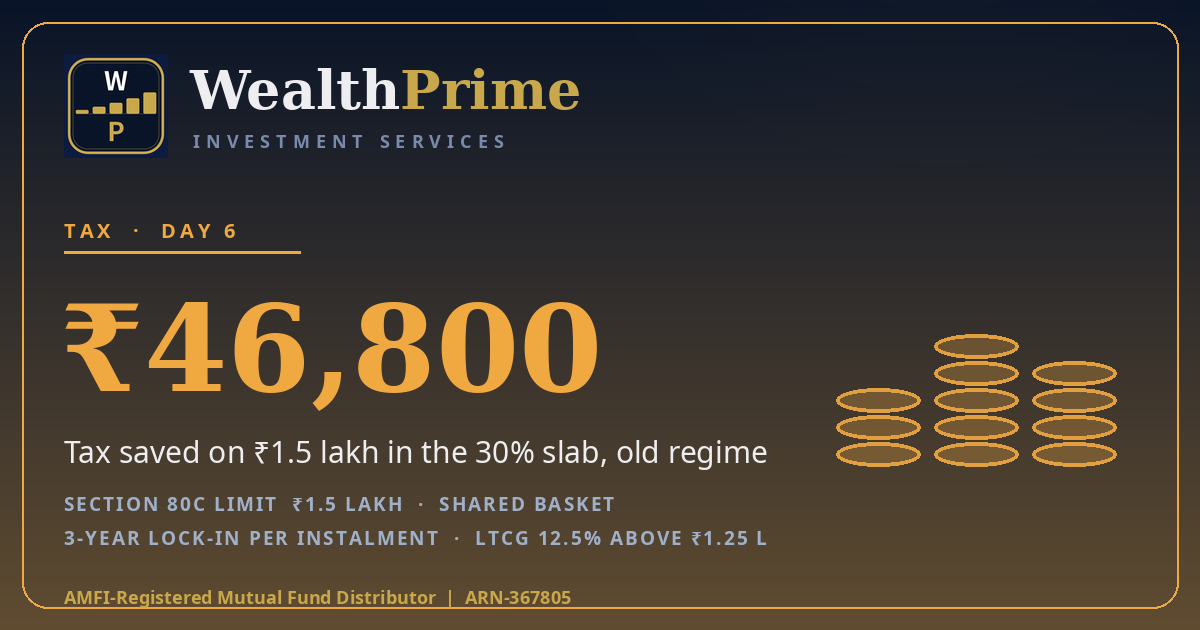
Take Meera, a salaried investor in the 30% slab under the old regime, who has no other 80C investments in the year — a clean case, chosen so the arithmetic is visible. She invests ₹1,50,000 in an ELSS fund as a lump sum and claims the full deduction. Her tax saving is ₹1,50,000 x 31.2% (30% plus 4% cess), which is ₹46,800. The investment's effective out-of-pocket cost, after the tax saving, is therefore ₹1,50,000 minus ₹46,800, which is ₹1,03,200 — but the full ₹1,50,000 is what is actually invested and locked in.
Now the growth side, stated as an illustration and nothing more. If that ₹1,50,000 grows at an assumed 12% per annum for the three-year lock-in period, it illustrates to about ₹2,10,739 at the end of year three (₹1,50,000 x 1.12 x 1.12 x 1.12 = ₹2,10,739), a gain of about ₹60,739. The 12% figure is an assumption chosen for illustration only — it is not a forecast, not a promise, and not what any particular fund has delivered or will deliver. A real three-year outcome could be materially higher or lower, and could even be a loss, because ELSS is an equity investment.
Readers who want to test their own numbers can use our SIP calculator for a monthly ELSS SIP (for example, ₹12,500 a month also totals ₹1.5 lakh in a year), changing the amount and the assumed return to see how sensitive the outcome is to each input. And readers comparing ELSS with PPF for the tax-saving slice can run the PPF side on our PPF calculator.
Tax at exit: LTCG, the ₹1.25 lakh exemption, and the lock-in's silver lining
When ELSS units are redeemed after the lock-in, the gains are taxed as long-term capital gains, because every redeemed unit has necessarily been held for more than 12 months — the three-year lock-in guarantees that. As of the publish date of this article, long-term capital gains on equity funds are taxed at 12.5% on gains above ₹1.25 lakh in a financial year, across all equity investments combined, and short-term gains do not arise on ELSS redemptions for exactly this reason.
Apply that to Meera's illustration. Her gain of about ₹60,739 sits below the ₹1.25 lakh annual exemption, so if she had no other equity gains in that financial year, no long-term capital gains tax would be due on that redemption. The exemption is annual and aggregate, though: gains from selling shares or other equity funds in the same year count toward the same ₹1.25 lakh limit, so an investor with large gains elsewhere may owe tax on part of the ELSS gain. Keeping capital-gains statements from every fund and broker makes filing season straightforward, and this section is general information, not personal tax advice.
There is also no exit load question to worry about in the usual sense: ELSS funds do not charge an exit load on redemption after the lock-in, because redemption before the lock-in is not possible at all. The cost to check is the fund's expense ratio, which for an actively managed ELSS fund is higher than an index fund's — the same cost gap our guide on index funds vs actively managed funds works through in numbers.
ELSS vs PPF for the tax-saving slice
The natural comparison for the tax-saving slice is PPF, and the two products answer different needs. PPF offers a government-backed interest rate (7.1% per annum as of the publish date of this article, reset quarterly by the government), a 15-year term, and EEE tax treatment — the investment, the interest and the maturity amount are all tax-free — which makes PPF the safety-first choice. ELSS offers market-linked growth potential with no assured return, a three-year lock-in, and tax on gains above the exemption at exit, which makes it the growth-seeking choice for money that can stay invested well beyond the lock-in.
The two are not rivals for the same rupee so much as different tools for different goals, and many investors use both: PPF for the safe, tax-free core of the 80C basket, ELSS for the equity portion of it. Our detailed comparison of PPF vs mutual funds covers the 15-year maths of that pairing. Investors who want to compare ELSS funds factually can browse the ELSS category in our fund explorer, checking each fund's costs and portfolio rather than relying on past returns — and past performance, where mentioned anywhere, is not indicative of future returns.
ELSS saves tax only under the old regime, only up to the unused room in the shared ₹1.5 lakh Section 80C basket, and only in exchange for a three-year lock-in on every instalment. Check the regime, check the basket room, then invest — never the other way round.
Frequently asked questions
Is ELSS tax-free at maturity?
No. The investment qualifies for a Section 80C deduction (old regime only, within the shared ₹1.5 lakh limit), but gains at redemption are taxed as long-term capital gains at 12.5% on gains above ₹1.25 lakh in a financial year, as of the publish date of this article. PPF, by contrast, is fully tax-free at maturity (EEE). Tax rules can change, so check the rules in force at redemption.
Can I withdraw ELSS money before three years in an emergency?
No. The three-year lock-in applies to every instalment from its own investment date, and ELSS units cannot be redeemed early for any reason, including emergencies. This is why ELSS money should never be money that might be needed within three years; an emergency fund should be built separately, before tax-saving investments.
Does ELSS save tax under the new tax regime?
No. Section 80C deductions, including ELSS, are available only under the old tax regime. Under the new tax regime, which is the default since financial year 2023-24, no 80C deduction is available. Compare total tax under both regimes first; if the new regime wins, ELSS buys no tax saving.
ELSS or PPF — which is better for tax saving?
Neither is universally better; they serve different purposes. PPF offers a government-backed rate (7.1% per annum as of the publish date, reset quarterly), a 15-year term and fully tax-free maturity. ELSS offers market-linked growth potential with no assured return, a three-year lock-in and taxable gains above the exemption. Many investors use both: PPF for safety, ELSS for the equity portion of the 80C basket. This is general education, not personal advice.
The bottom line
ELSS is the only mutual fund that saves tax, and that distinction comes with three conditions that must all be checked: the investor must be in the old tax regime, there must be unused room in the shared ₹1.5 lakh Section 80C basket, and the money must be affordable to lock away for three years per instalment. When all three hold, the maths is attractive — a ₹1.5 lakh investment in the 30% slab saves ₹46,800 of tax, and the same sum illustrates to about ₹2,10,739 after three years at an assumed 12% per annum, with gains below the ₹1.25 lakh exemption attracting no LTCG tax if there are no other equity gains that year. When any condition fails, ELSS is just an ordinary equity fund with a lock-in attached. Check the regime, check the basket, keep the lock-in in mind — and never buy ELSS in a January rush.
Sources: Section 80C of the Income-tax Act (₹1.5 lakh limit, shared basket); SEBI's ELSS category rules (minimum 80% in equity, three-year lock-in per investment); Budget 2024 long-term capital gains rate of 12.5% with a ₹1.25 lakh annual exemption for equity; PPF interest rate of 7.1% per annum as of the publish date; the worked figures are the author's own calculations from the stated assumptions. Tax rules are stated as of the publish date and can change.
Check Your 80C Room Before You Invest
ELSS only saves tax if you are in the old regime with room left in your ₹1.5 lakh basket. Talk to us on a free, no-pressure call about sizing your tax-saving investments correctly.
Prefer chat? WhatsApp us