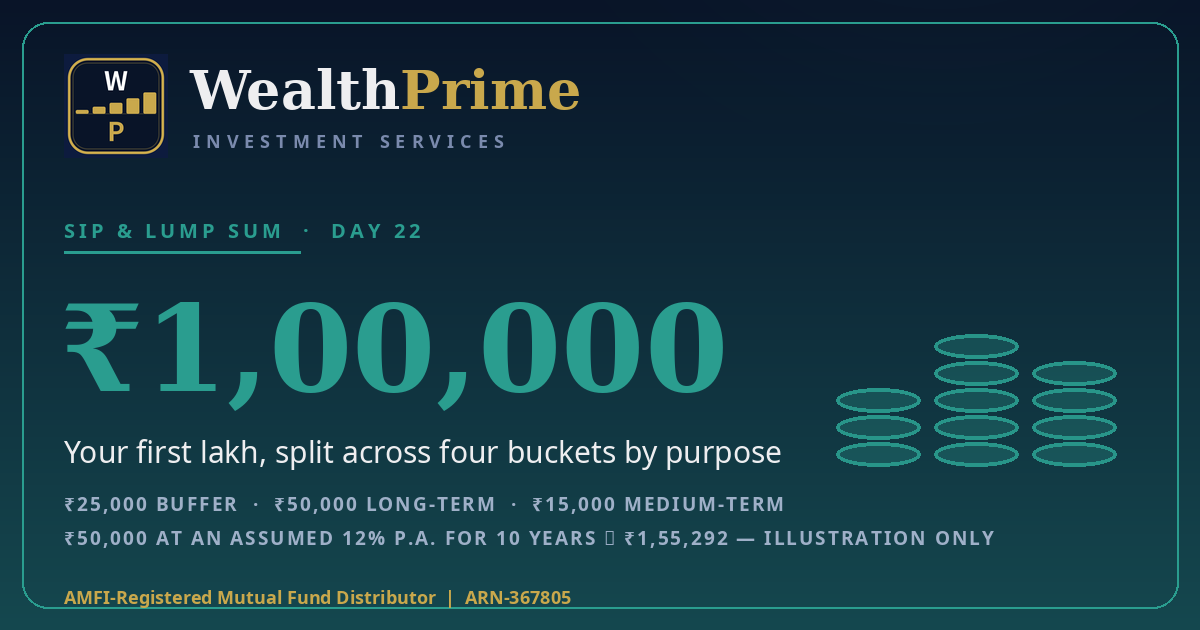
The first ₹1 lakh feels different from every lakh that follows it. A first ₹1 lakh usually arrives slowly — a bonus, a matured deposit, a year of small savings finally adding up — and the saver who built it faces one anxious question: where should this money go so that it works hard without needless risk?
The anxious question has a calmer answer than the saver expects. A first ₹1 lakh does not need one perfect home; the ₹1 lakh needs a plan that splits the money by purpose and by date, so that each part sits in a place that matches when the part will be spent. This article walks through that plan in order: the two checks that come before any investing, a four-bucket split of the full ₹1,00,000, a worked example with the arithmetic shown, the choice between investing at once and moving the money in stages, the mistakes that cost first-time investors the most, and a 30-day action list.
Before a single rupee is invested: two checks
The first check is the emergency buffer. An investor who holds no emergency savings and invests the entire ₹1 lakh in market-linked funds has built a plan that the first emergency will break: a job gap, a hospital bill or an urgent repair will force a sale of units on whatever day the bill arrives, at whatever NAV that day carries. A starter buffer changes that sequence. The buffer does not need to be complete before investing begins — a full emergency fund of three to six months of essential expenses takes time — but the first slice of the ₹1 lakh belongs to the buffer, so that investing and safety grow together. Our guide on how much emergency fund to hold, and where to park the emergency fund, sets out the full target and the order in which to build it.
The second check is protection and expensive debt. A family with no term cover and no health cover carries risks that no investment return can repair, and a first ₹1 lakh should not be fully committed while the family’s basic protection is unexamined. Expensive debt deserves the same pause. A credit-card balance or a personal loan charging interest well above any return an investor can reasonably illustrate will outgrow the investments placed beside it, and clearing high-cost debt is a certain saving of the interest rate charged. An investor carrying such debt should weigh repayment as the first bucket of all.
Splitting ₹1 lakh into four buckets
With the two checks done, the ₹1 lakh divides by one question per rupee: when will this money be spent? Money needed within a year cannot ride out a market fall; money not needed for a decade wastes its years sitting idle. The split below is an education walkthrough, not a recommendation — the proportions move with the reader’s own expenses, goals and existing savings — but the four purposes cover what a first ₹1 lakh is usually asked to do.
| Bucket | Amount | Purpose | Time horizon |
|---|---|---|---|
| Emergency buffer starter | ₹25,000 | The first slice of the safety net, in a savings account or a liquid fund, reachable within days | Available any time |
| Long-term growth | ₹50,000 | Goals a decade away — retirement, a child’s higher education — in equity mutual funds | 7 years or more |
| Medium-term goals | ₹15,000 | A goal three to five years away, in debt or conservative hybrid categories where falls are smaller | 3–5 years |
| Flexibility cash | ₹10,000 | Unassigned money in the savings account: a buffer against a thin month | Available any time |
The four buckets add to exactly ₹1,00,000 — ₹25,000 plus ₹50,000 plus ₹15,000 plus ₹10,000 — and each bucket’s home follows from its horizon, not from a return chase. The buffer and the flexibility cash stay liquid because their job is availability. The medium-term bucket accepts modest movement because its goal is years away but not a decade away. Only the long-term bucket takes full equity-market movement, because only that bucket has the years a recovery needs. An investor who already holds a complete emergency fund can move the buffer slice into the goal buckets; an investor starting from zero may build the buffer first. The frame matters more than the exact percentages.
The worked example: what the long-term bucket has time to do
Take only the long-term bucket — ₹50,000 — and give the bucket the one gift a first-time investor actually controls: time. If ₹50,000 stays invested for 10 years at an assumed 12% a year, the amount grows to ₹50,000 multiplied by 3.1058, which equals ₹1,55,292. The growth of ₹1,05,292 comes entirely from compounding: each year’s gain joins the principal and earns alongside it in the years that follow. At an assumed 8% a year instead, the same ₹50,000 grows to ₹1,07,946. Both figures are illustrations at the assumed rates, not forecasts or guarantees of what any fund will earn, and past performance is not indicative of future returns; a real fund will rise and fall along the way and will not follow either smooth line.
The two illustrations carry the lesson together. The gap between ₹1,55,292 and ₹1,07,946 — ₹47,346 — comes from the assumed rate alone, on the same money over the same years, which is why honest planning treats the return as the unknown and the time and the amount as the decisions. The buffer bucket, by contrast, is not failing when the buffer earns a savings-account rate: the buffer’s return is measured in emergencies absorbed without a forced sale, not in percentages. A reader who wants to test other amounts, years and assumed rates can run the same arithmetic in the lump sum calculator.
A first ₹1 lakh works when each part is matched to its date: ₹25,000 starts the safety net, ₹50,000 takes the decade-long growth role, ₹15,000 serves a three-to-five-year goal, and ₹10,000 stays flexible. The split protects the plan; the years, not cleverness, do the growing.
Investing the long-term bucket: at once, or in stages?
The ₹50,000 long-term bucket raises the oldest question in this series: invest the whole amount today, or move the amount into equity in stages? Investing at once puts every rupee to work immediately and accepts whatever the market does next. A Systematic Transfer Plan, or STP, parks the amount in a debt fund of the same fund house and moves a fixed slice into the chosen equity fund each month — ₹10,000 a month for five months, in this example — so the entry price is averaged across five NAVs instead of one. Our explainer on how an STP moves a lump sum into equity works through the mechanism and its limits in full.
Neither route changes the destination, and the honest difference is behavioural as much as mathematical. An investor who invests at once and then watches a fall in the first month must hold the full position through the discomfort; an investor who stages the entry watches early falls arrive while part of the money still sits in the debt fund, which makes holding on easier for many first-time investors. The staged route costs a little expected growth in a rising market, because part of the money waits in a lower-yielding fund for a few months. A first ₹1 lakh is as much a training amount as an investment amount: the route the investor can actually stay with is the route worth choosing. Investors comparing schemes for any bucket can compare funds across categories in the explorer, where each fund’s category, expense ratio and stated facts sit side by side.
What not to do with a first ₹1 lakh
Four mistakes recur so reliably with first lump sums that each deserves a plain naming. The first is chasing a tip: a stock, a sector or a fund named in a group chat carries no analysis the saver can check. The second is trading the amount — derivatives, intraday positions and leveraged bets can consume a small corpus in weeks, and the corpus took far longer to save. The third is buying a bundled insurance-cum-investment product in a hurry: such products lock money in for years and blend cover and investing in ways that serve neither purpose well. The fourth is the quietest: leaving the entire ₹1 lakh in a savings account for years out of caution, where inflation steadily reduces what the money can buy. Caution belongs in the bucket design — a quarter of this plan never touches the market — not in postponing the whole plan.
The 30-day action list
A plan that stays on paper earns nothing, so the walkthrough ends with dates. In the first week, the investor completes the two checks: one month of essential expenses totalled, the family’s existing protection noted, and any high-cost debt listed. In the second week, the investor completes KYC for mutual fund investing, if the KYC is not already in place, and moves the ₹25,000 buffer slice and the ₹10,000 flexibility slice to their homes. In the third week, the investor places the medium-term ₹15,000 and starts the long-term ₹50,000 on the chosen route, at once or by STP. In the fourth week, the investor does the step that outlasts the lakh itself: a monthly SIP from salary starts, even a small one, so that the second lakh builds automatically instead of waiting for another windfall. Our guide on stepping a SIP up with each salary raise shows how that monthly amount can grow with income over the years that follow.
Frequently asked questions
How should a beginner invest a first ₹1 lakh?
A beginner splits the ₹1 lakh by when each part will be spent, after checking the emergency buffer and the family's basic protection. One illustrative split places ₹25,000 in an emergency buffer, ₹50,000 in long-term equity funds for goals seven or more years away, ₹15,000 in debt or conservative categories for a three-to-five-year goal, and ₹10,000 as flexibility cash. The proportions are an education example and should follow the reader's own expenses, goals and existing savings.
Should I invest ₹1 lakh all at once or through an STP?
Investing at once puts the full amount to work immediately and exposes the full amount to the next market move. An STP parks the amount in a debt fund and moves a fixed slice — ₹10,000 a month for five months on a ₹50,000 bucket — into the equity fund, averaging the entry price across several NAVs. The staged route usually suits an investor who would find an early fall on the full amount hard to hold through; neither route changes the long-term destination.
How much of my first ₹1 lakh should stay out of the market?
In the illustrative split in this article, ₹35,000 of the ₹1 lakh — the ₹25,000 emergency buffer starter and the ₹10,000 flexibility cash — stays out of market-linked funds entirely, because both amounts exist to be available on any day. An investor with no emergency savings at all may keep more out of the market at first; an investor whose emergency fund is already complete may keep less. The share follows the safety net, not a fixed rule.
What returns will ₹1 lakh earn in 10 years?
No return can be promised, and any figure is an illustration at an assumed rate. In this article's worked example, ₹50,000 invested for 10 years at an assumed 12% a year grows to ₹1,55,292, and at an assumed 8% a year the same ₹50,000 grows to ₹1,07,946. A real fund's return will differ from both illustrations, will arrive unevenly, and past performance is not indicative of future returns.
The bottom line
A first ₹1 lakh does not need a brilliant home; the ₹1 lakh needs four ordinary homes matched to four dates. Check the safety net and the protection first, place ₹25,000 toward the emergency buffer, give ₹50,000 the decade-long growth job, set ₹15,000 against a medium-term goal, keep ₹10,000 flexible, and then start the monthly SIP that builds the next lakh without waiting for a windfall. The saver who follows that sequence has built a system, and systems survive the market moods that defeat one-off decisions.
Sources: All ₹ investment figures are the author’s calculations at the stated assumptions — ₹50,000 compounded for 10 years at an assumed 12% a year (₹1,55,292) and at an assumed 8% a year (₹1,07,946) — illustrations, not forecasts. The bucket split is the author’s education walkthrough; STP mechanics are as described in the author’s STP explainer, from fund houses’ published scheme documents. Emergency-fund sizing follows the author’s emergency fund guide.
First ₹1 Lakh Sitting Idle in a Savings Account?
A split by purpose — buffer, long-term, medium-term, flexible — puts every rupee in a home matched to its date. Talk to us on a free, no-pressure call about building your deployment plan, bucket by bucket.
Prefer chat? WhatsApp us